Upper Mustang Trek, trekking into the 'Forbidden Kingdom of Mustang offers a unique opportunity to explore ancient Tibetan culture and visit remote monasteries and caves. The Upper Mustang trek is a journey into the mystical landscapes of the former Kingdom of Lo, nestled amidst the Annapurna and Dhaulagiri ranges. This restricted area trek offers a unique chance to explore ancient Tibetan-influenced culture, rugged terrain, and captivating desert-like landscapes. Beginning in Pokhara, the trek follows ancient trade routes through barren valleys, deep gorges, and towering cliffs, offering mesmerizing views.
Highlights include the fortified town of Lo Manthang-the capital of the former Kingdom of Mustang, known for its ancient palaces, monasteries, and traditional Tibetan architecture, and the legendary "Sky Caves" of Mustang, providing a glimpse into the region's rich history and cultural heritage, including monasteries, chortens, and ancient cave dwellings. With its remote location, unique culture, and stunning beauty, the Upper Mustang trek is an unforgettable adventure for trekkers seeking to explore Nepal's Himalayan hinterlands.
Witnessing the vibrant Tiji Festival-a three-day celebration of Tibetan Buddhism, featuring masked dances, rituals, and cultural performances-adds a unique cultural experience.
Highlights
Explore the tranquil routes that pass through ethnic villages and lush farmlands
Encounter the most hospitable locals waiting with a warm meal and a cozy bed
Feel nature as most of route passes through the lush forests of rhododendron, pines, and oaks
Traverse the novel, less explored paths to reach to Mardi Himal Base Camp
Catch the stunning views of Mardi Himal, Machhapucchre, Hiunchuli, and Annapurna
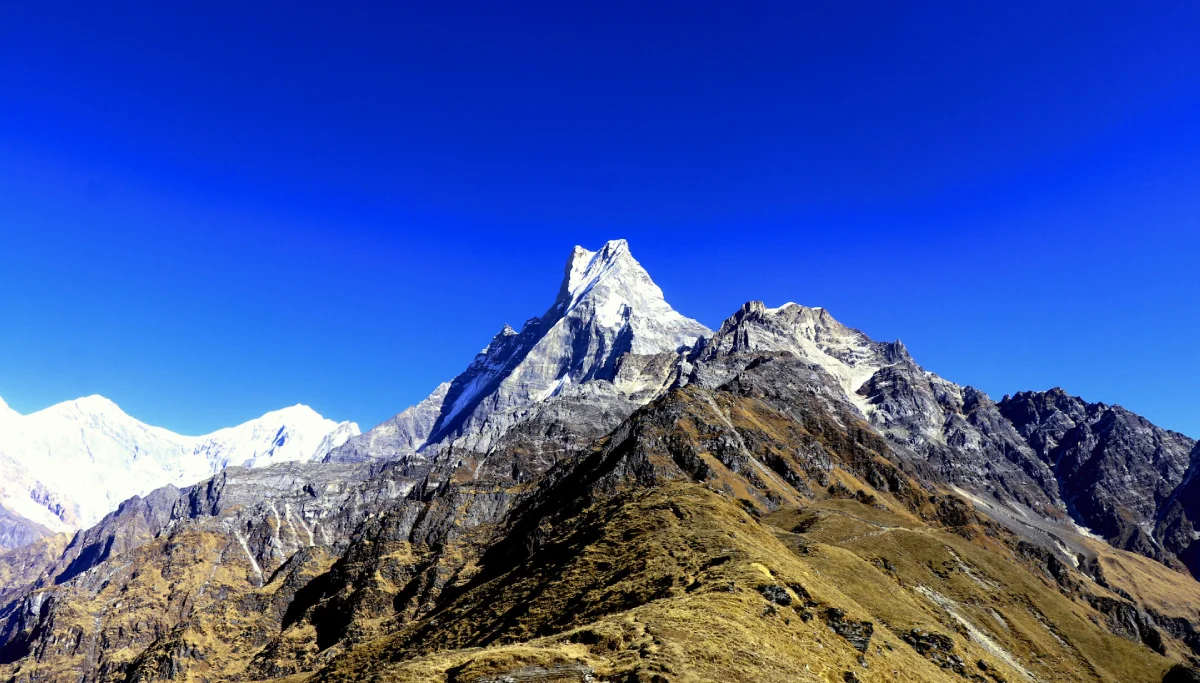
Majestic view of the Holy Machhapuchare mountain (Mt. Fishtail at 6,993 m), and the Annapurna Range.
Itinerary (10D, 9N)
Arrival in Tribhuvan International Airport in Kathmandu, the capital city of Nepal. You will be received by one of our representatives upon your arrival and then transferred to your hotel. Check into the hotel and take your time and rest or explore the happening streets of Thamel yourself. Thamel is full of energy: lots of shops and traditional Nepali restaurants-just think of it. This day is for preparation and relaxing, thus getting ready for the actual adventure.
Before starting your trekking journey, we have set aside a day in Kathmandu to help you learn about the unique art, culture, and architecture of Nepal. You will be guided to the UNESCO-listed heritage sites in Kathmandu. First, you will be escorted to Kathmandu Durbar Square, where you can visit the museum, palace, its premises, and the temples built around it. Next, you will be escorted to the monkey temple – Swayambhunath. We walk up the stairs to the stupa. From the height, we can get an excellent view of Kathmandu city. Then, we visit a popular Hindu temple – Pashupatinath temple and head towards the largest stupa in the world – Boudhanath stupa. In the evening, we return to our hotel for an overnight stay
After breakfast, board the early morning tourist bus from Kathmandu to Pokhara. Tourist buses are more comfortable than other public transport in Nepal so there shouldn’t be an issue with youngish children. Climbing out of the valley, the road winds downhill and meets the Rapti River on the way.
Following the Rapti River, you may see rafters enjoying the white water as they rise and fall with the waves. There are plenty of good stopping points along this route and the bus will stop for lunch at one of them.
Turning off at Mugling, the bus heads along a flat road for the last few hours until you reach Pokhara in the afternoon.
You can explore Pokhara – perhaps take a walk around Phewa Lake or go boating.
After breakfast it’s a short drive to Kande where you will start hiking. The trek starts off with an uphill gradual climb to a small settlement called Australian Camp which has good views of the Annapurna range. After taking some refreshments here its around two hours further walk to Deurali.
The trails take you through some beautiful small villages where you can see first hand how the local people are living in this beautiful countryside. You will pass through rhododendron forests, which will be alive with red blooms in the spring, while overhead you will see Mt Machhapuchhre (commonly known as Fishtail because of its shape) that also dominates the town of Pokhara
Today’s trek takes you from the peaceful village of Deurali (2,200 m) into the heart of the forested hills of the Mardi Himal trail. The route climbs steadily through dense rhododendron and oak forests, offering occasional clearings with views of Machapuchare (Fishtail) peeking through the trees. The trail becomes narrower and more secluded, creating a serene, almost mystical atmosphere as you gain elevation.
After about 3 to 4 hours of trekking, you’ll arrive at Low Camp (2,900 m), where the vegetation starts to thin and the air becomes noticeably cooler. Low Camp offers limited but cozy teahouse accommodations and the first panoramic glimpses of the Annapurna South and Machapuchare ranges above the treetops. It’s an ideal spot to relax, acclimatize, and enjoy the peaceful surroundings before heading into higher alpine terrain.
After breakfast, set off towards High Camp. With an elevation gain of almost 700m / 2,296.5 ft, you may feel the effects of this high altitude. The guide will ensure you take plenty of breaks and drink plenty of water to stay hydrated.
You will hike through more rhododendron forests today and whereas at the lower altitude on Day 2 and Day 3 you may have seen some larger wildlife – monkeys, for example, at this higher altitude it is more likely you will see only mammals such as the Himalayan Marmot (a type of ground squirrel) or Himalayan tahr (wild goats). There will be plenty of birdlife including the Danphe (a pheasant) which is Nepal’s national bird.
The mountains you will see today are Annapurna South, Mardi Himal, Hiunchuli and Machhapurchhre, these are all particularly clear at the village of Badal Danda (danda meaning hill).
Trekking on you leave the treeline behind until you reach High Camp.
This may be the most challenging day of the trek as the trails are uneven and can be slippery. Snow is another possibility depending on the time of year you are there.
Even if crampons are not needed, we highly recommend you using walking poles today even if you have not used them so far on this trek. Depending on the condition of the trail, which your guide will advise you of, should you not with to hike to base camp with children and/or seniors, your guide will offer a short, lower altitude alternative.
For those heading to base camp, it is recommended to leave very early in the morning in order to reach there before the high winds come in and while the weather is still clear so that the views are the best they can be. If you start early enough you will catch sunrise also!
The views from a view point just before the base camp and from Mardi Himal Base Camp itself are simply amazing. After spending some time being awed by the mountains, retrace your steps back to Badal Danda where the views are also excellent.
This may be the most challenging day of the trek as the trails are uneven and can be slippery. Snow is another possibility depending on the time of year you are there.
Even if crampons are not needed, we highly recommend you using walking poles today even if you have not used them so far on this trek. Depending on the condition of the trail, which your guide will advise you of, should you not with to hike to base camp with children and/or seniors, your guide will offer a short, lower altitude alternative.
For those heading to base camp, it is recommended to leave very early in the morning in order to reach there before the high winds come in and while the weather is still clear so that the views are the best they can be. If you start early enough you will catch sunrise also!
The views from a view point just before the base camp and from Mardi Himal Base Camp itself are simply amazing. After spending some time being awed by the mountains, retrace your steps back to Badal Danda where the views are also excellent.
Drive from Sidhing to Pokhara before continuing by tourist bus, private vehicle, or domestic flight to Kathmandu. Spend your final evening shopping, relaxing, or enjoying a farewell dinner.
you will be picked up from your hotel and transferred to the international airport for your final departure. Make sure to have your travel documents ready and arrive at the airport at least three hours before your flight. Therefore, this is the end of your trek and journey in Nepal. Safe travels, and hope to see you again.
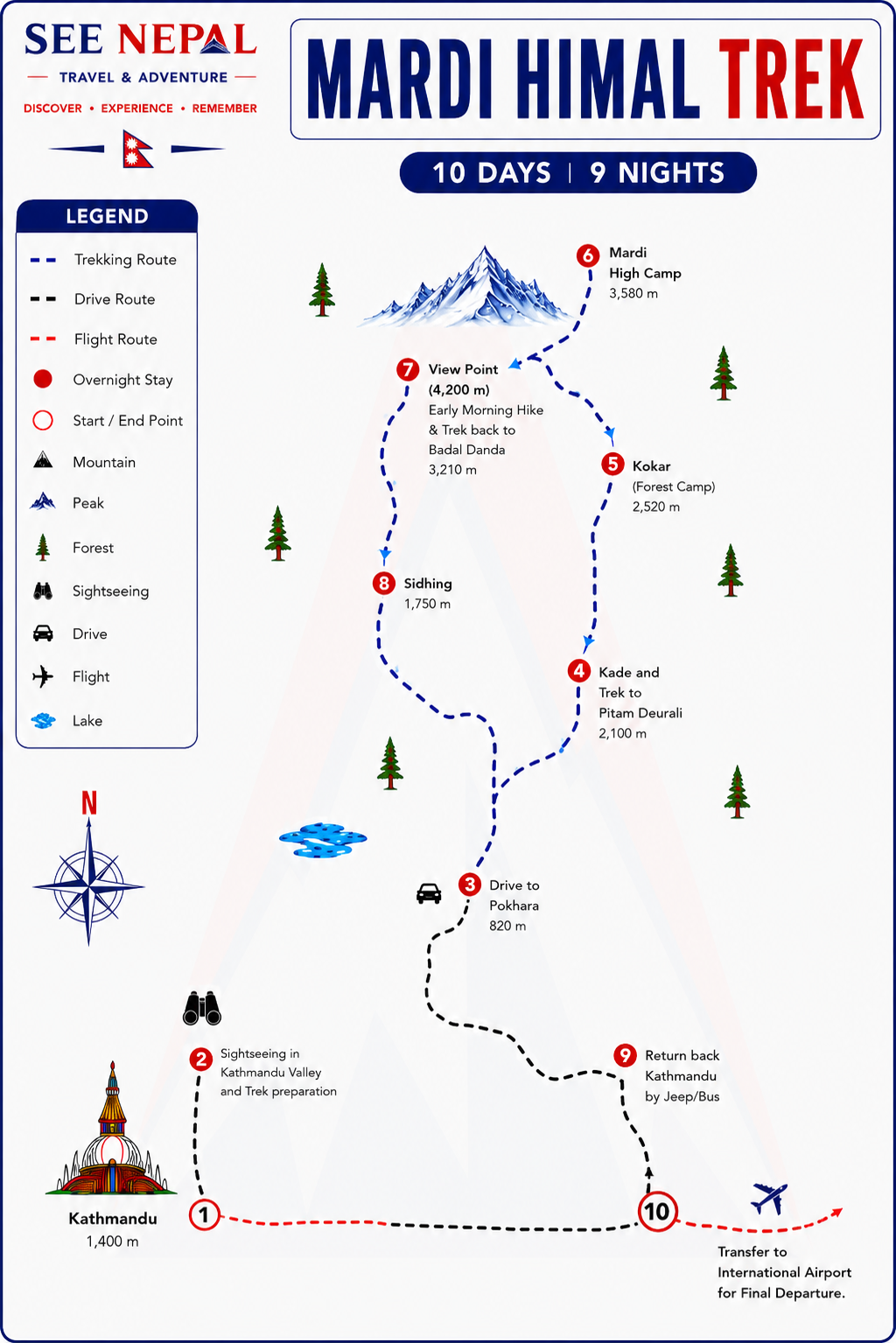
Trekking Map
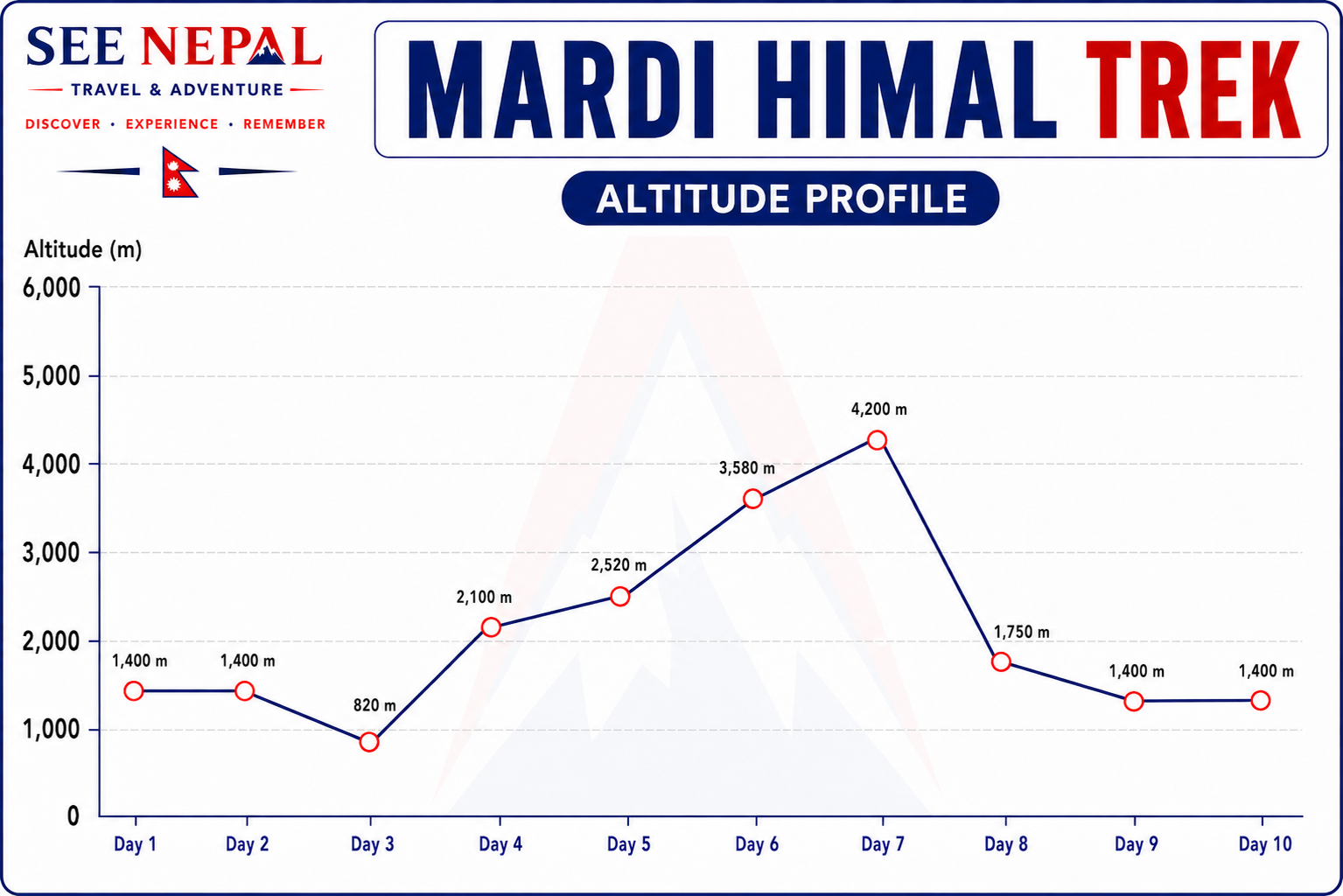
Altitude Profile
Inclusions & Exclusions
What's Included
Pickup from Kathmandu International Airport based on your arrival date and time.
2 nights accommodation in Kathmandu on BB plan (one night before the start of the trek and one night after the trek)
2 Nights accommodation Pokhara on BB Plan (one night before starting the trek and one night after the trek)
Tourist bus ticket to Pokhara from Kathmandu
Taxi to Birethanti (trek start point) from Pokhara
Three times meals (Breakfast, Lunch, and Dinner) during the trek
8 nights accommodation during the trek (tea house)
All necessary permits for Poon Hill Mardi Himal Trek
An experienced and qualified English-speaking guide including his expenses for food, lodge, transportation, salary, insurance, equipment, etc.
Sharing JEEP to Pokhara from Siding village (trek endpoint)
Government VAT and official expenses
Purified drinking water (Ef-Chlor – water purification tablet)
Certificate of achievement (If needed)
Farewell dinner in Nepali restaurant in Thamel before you depart from Nepal
Free luggage stored at Green Valley Nepal Store During the Trek
An airport transfer service for your final departure
What's Excluded
International airfare, Nepal visa fee and any kind of insurance
Lunch, Dinner and extra night accommodation in Kathmandu
Porter to carry your luggage during the trek (if you worlid like to take a porter to carry your stuff it will cost you USD 220 each porter, who can carry maximum 25 KG)
expenses during the trekking such as hot shower, all kind of drinks, extra meals, Wi-Fi or data, battery charging, upgraded accommodation etc..
Tips for Staffs ( it is expected)
Equipment List
Clothing
Footwear & Sleeping Gear
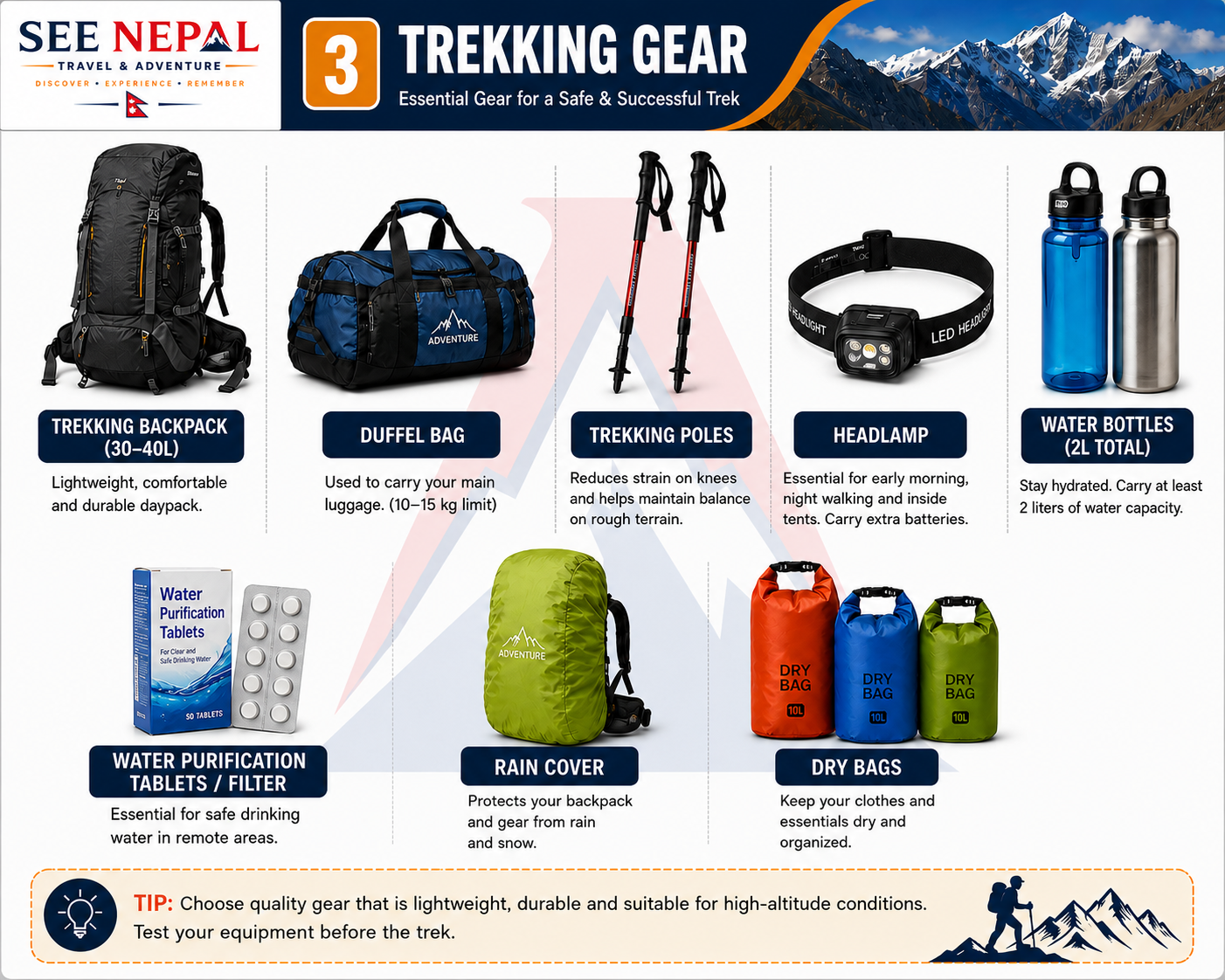
Trekking Gear
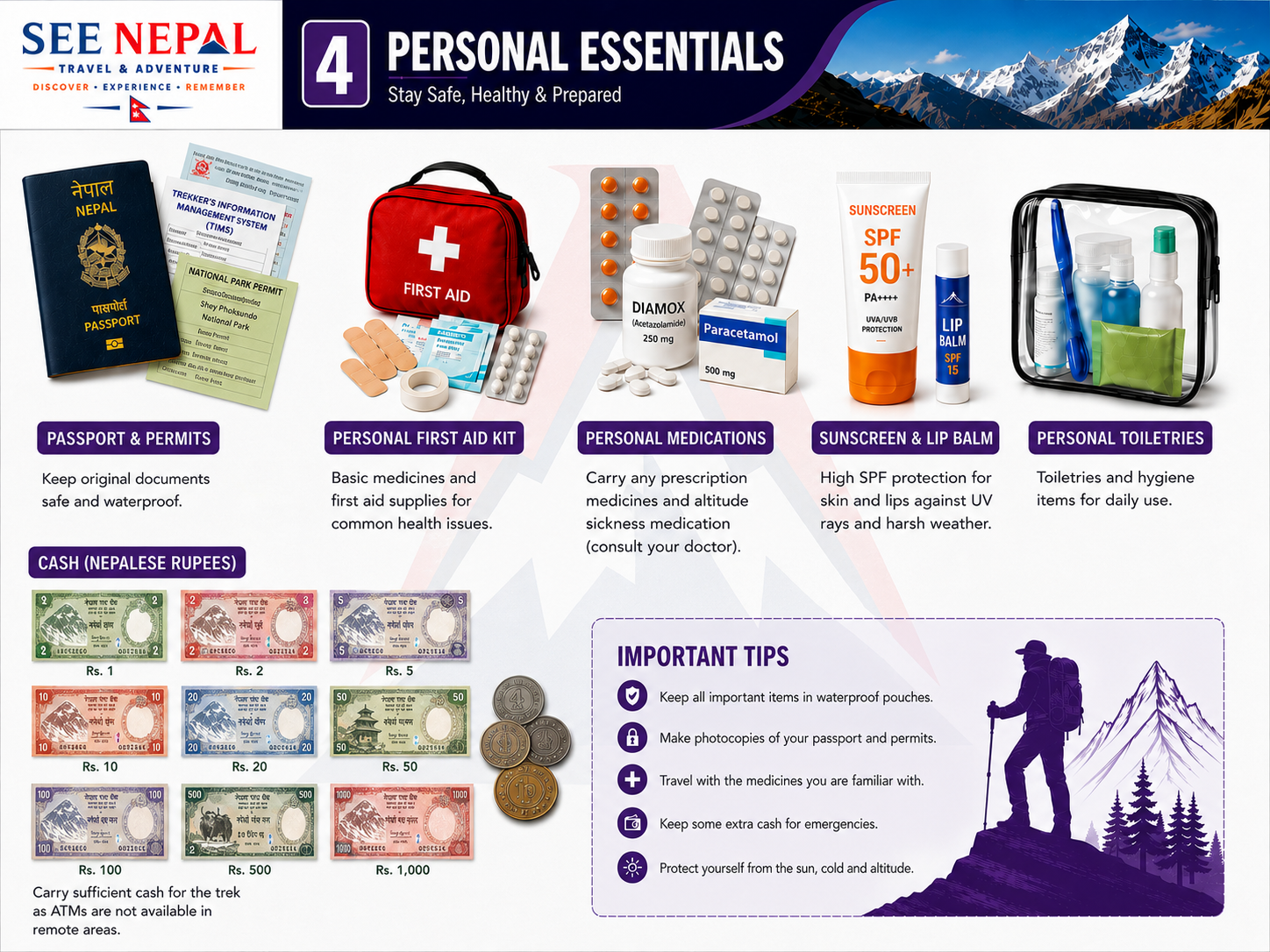
Personal Essentials
Electronics & Food
Frequently Asked Questions
The Mardi Himal Trek cost usually ranges from USD 450 to USD 900 per person, depending on the number of days, group size, and level of service. A basic package with a guide and standard teahouse accommodation costs less, while a private or luxury trip costs more.
Yes, the Mardi Himal Trek is suitable for beginners with a basic level of fitness. The trail is relatively short and less crowded compared to other treks in Nepal, but it still includes some steep sections and altitude gain.
The climb from High Camp to Mardi Himal Base Camp is the most demanding due to steep ascent and altitude. However, it is short and manageable with proper pacing.
Starting early (around 6:30–7:30 AM) is ideal for clear mountain views and avoiding afternoon clouds. Our guides usually adjust the timing based on weather and group pace.
Unlike Everest region treks, Mardi Himal does not require flights. The journey starts by road from Kathmandu to Pokhara, making it more reliable and less prone to delays.
Yes, the trek can be shortened to 4–5 days or extended with side trips depending on your schedule. We can adjust the itinerary based on your time and fitness.
Safety always comes first. If reaching base camp is not possible, High Camp still offers spectacular views of Machhapuchhre and the Annapurna range, making the trek worthwhile.
Yes, most tea houses offer charging facilities for a small fee. It’s recommended to carry a power bank as backup, especially at higher altitudes.
Yes, but with conditions:
Monsoon (June–Aug): Lush greenery but limited views
Winter (Dec–Feb): Snow and cold, but clear skies
Spring and autumn remain the best seasons.
This trek is popular among:
First-time trekkers
Couples and small groups
Travelers looking for a short Himalayan experience
Bottled water is available but not environmentally friendly. We recommend using water purification tablets or filtered water provided at tea houses
Most Mardi Himal Trek packages include the following:
Guide and porter (if added from the add-on option) service
Accommodation during the trek (Tea Houes)
Meals (breakfast, lunch, and dinner) during the trek
All neccessary Trekking permits
Transportation (Kathmandu–Pokhara–Kathmandu)
Always check the package details, as inclusions may vary by company.
Typically, the cost does not include:
International flights
Nepal visa fees
Travel insurance
Personal expenses (WiFi, hot shower, drinks)
Tips for guide and porter
These extra costs can add around USD 100–200 depending on your spending.
Extra costs include WiFi, hot showers, drinks, snacks, tips, travel insurance, and personal expenses.
Yes, Mardi Himal Trek is generally cheaper because it is shorter and less commercial compared to Annapurna Base Camp Trek.
There are showers at Deurali and Siding. Both the High Camp and the Rest Camp lack showers. You may use a bucket to take a shower if you want to.
Only the urban regions of Nepal, including Kathmandu and Pokhara, accept credit cards. Credit cards are not accepted when you enter the hiking area. You must thus have adequate cash on hand.
In most cases, the trip leader will assist and support you to descend to a lower altitude if you fall ill. We will set up an emergency helicopter evacuation service if you are critically ill or hurt. Depending on the scenario in the mountains, our guide will respond right away. Ensure that you have travel insurance that includes coverage for both high-altitude trekking and emergency evacuation services.
The staff at Green Valley Nepal Treks has successfully guided several treks for women traveling alone in the Himalayas of Nepal. While seeing Mardi Base Camp with us, you will feel 100 percent protected. We promise that your vacation will remain in your memory for the rest of your life.
We will provide one porter for every two trekkers, depending on the size of the group. Throughout the walk, the porter will carry 12 to 15 kg of baggage per person. You must carry your daypack to store your personal items, such as your wallet, camera, water bottle, dry food, headlamp, and other electronics. Please only carry items that are absolutely necessary.
Yes, there are many tea houses along the walk path, however during the busy season, they could fill up. When choosing the best time to embark on the Mardi Himal trip, you must be extremely vigilant about the accommodations.
The Mardi Himal Trek's highest point is 4500 meters above sea level. Similar to that, the Mardi Himal Trek from Pokhara covers a total of roughly 68 kilometers.
The journey can definitely be extended by a few extra days. We may add days to your journey at your request, but there will be an extra charge to cover guides, porters, lodging, and food.