The Annapurna Circuit Trek is a legendary journey through the heart of the Annapurna mountain range, offering trekkers an immersive experience in Nepal's diverse landscapes and cultures. This iconic trek begins in the lush valleys and terraced fields of the lower Himalayas before ascending into the rugged alpine terrain of the Annapurna massif, including Annapurna i (8,091m).
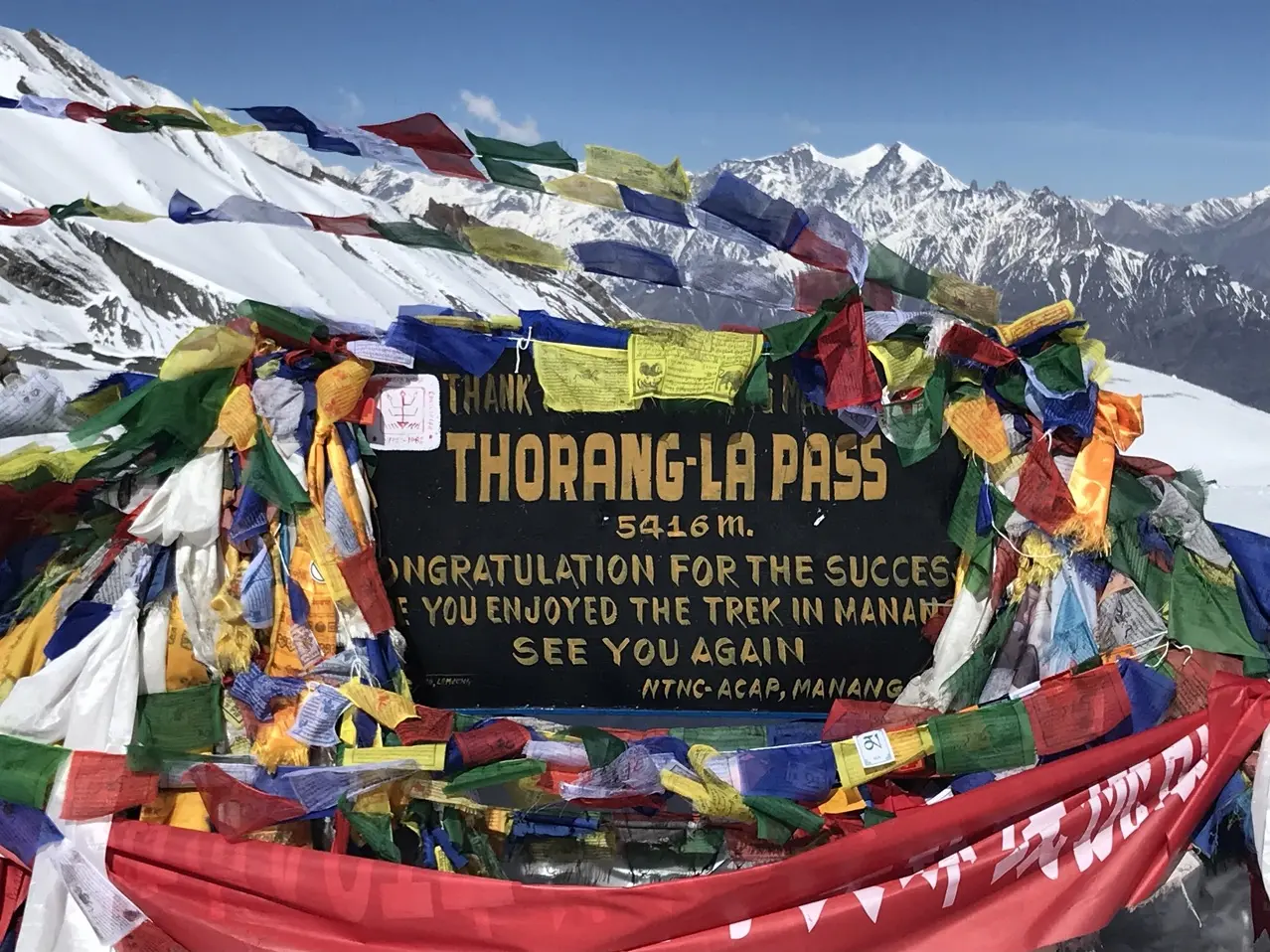
A diverse trek offering views of the Annapurna and Dhaulagiri ranges. As you traverse the ancient trade routes and remote mountain villages, you'll be greeted by stunning views of snow-capped peaks, cascading waterfalls, and dense rhododendron forests. The trek reaches its pinnacle at Thorong La Pass, one of the highest mountain passes in the world at 5,416 meters, where you'll be rewarded with panoramic vistas of the surrounding Himalayan peaks, including the majestic Mt. Annapurna I towering at 8,091 meters.
Throughout the journey, trekkers have the opportunity to immerse themselves in the rich cultural heritage of the region, interacting with local communities and visiting sacred monasteries and temples along the way.
Cultural immersion: diverse ethnic communities (Gurung, Magar, Thakali, Chhetri/Brahmin); ancient monument and religious sites (monasteries, chortens, temples); such as Kagbeni, Muktinath etc.
Natural Hot Springs: Relaxing and rejuvenating in natural hot springs at Tatopani.
Itinerary (The trek can be started from the either end point of the trail)
Highlights
Thorong La Pass (5,416 m) – One of the highest trekking passes in the world and the trek’s biggest highlight.
Annapurna & Dhaulagiri Mountain Views – Spectacular panoramas of Annapurna I, II, III, IV, Dhaulagiri, Machhapuchhre, and more.
Muktinath Temple (3,800 m) – Sacred pilgrimage site for Hindus and Buddhists.
Kali Gandaki Gorge – The world’s deepest gorge between Annapurna and Dhaulagiri.
Manang Village – Beautiful Himalayan village ideal for acclimatization with stunning scenery.
Tilicho Lake (Optional) – One of the highest lakes in the world.
Jomsom & Marpha – Traditional Thakali villages, famous for culture and apple orchards.
Tatopani Hot Springs – Natural hot springs to relax after trekking.
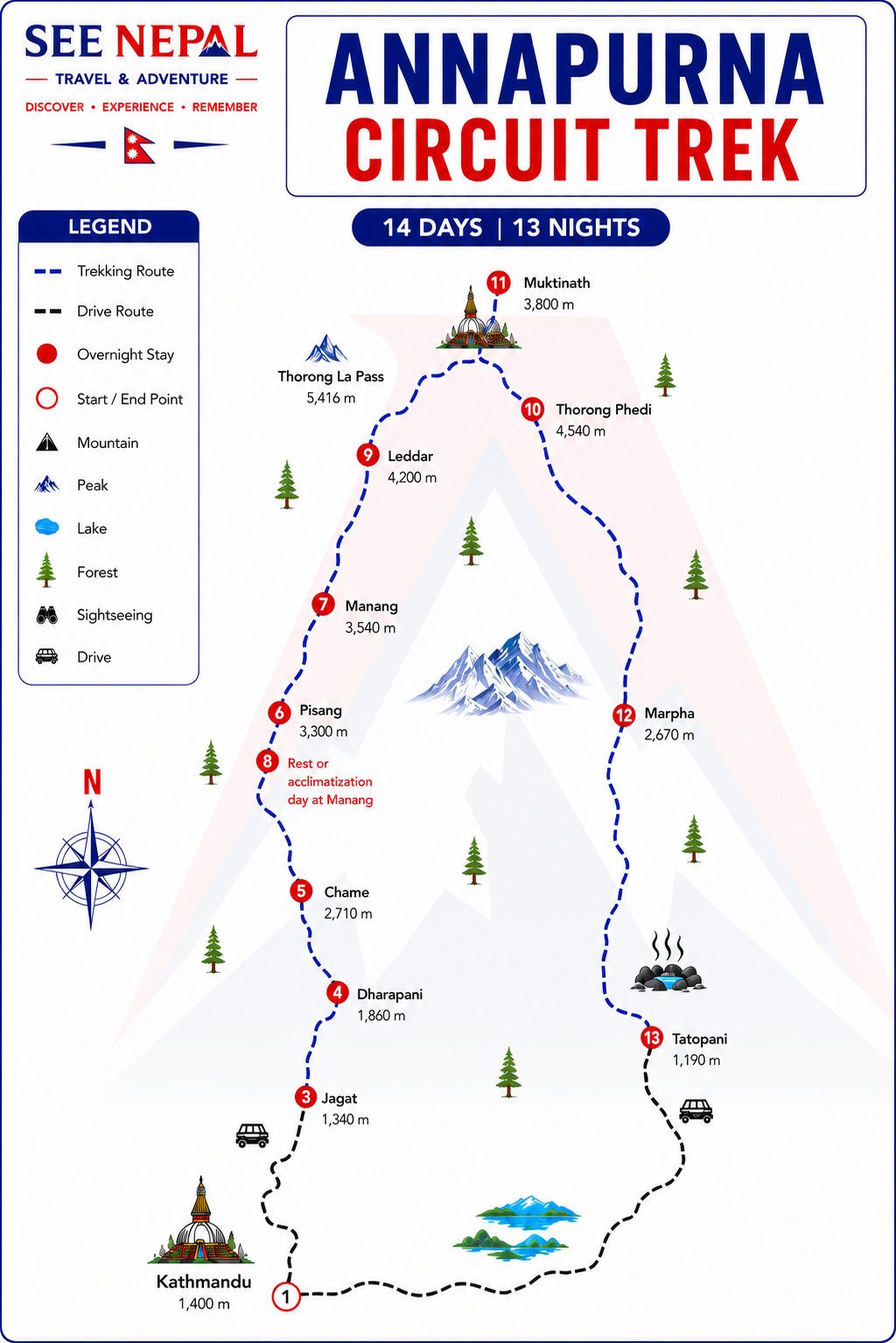
Itinerary (14D,13N)
Nepal Intrepid Treks will be your dedicated travel companion until you return to your home country. Once you arrive at Kathmandu airport, we will be there to pick you up and take you to your hotel. Accommodation for our valued customers includes room and breakfast in a three star hotel in Kathmandu. Take in the impressions of Nepal as we drive you from the airport to your hotel. We will assist you with the check-in and provide you with further information regarding your Everest Base Camp Trek. You may then have a rest or stroll through the bustling, colorful streets and alleys of Kathmandu.
Before starting your trekking journey, we have set aside a day in Kathmandu to help you learn about the unique art, culture, and architecture of Nepal. You will be guided to the UNESCO-listed heritage sites in Kathmandu. First, you will be escorted to Kathmandu Durbar Square, where you can visit the museum, palace, its premises, and the temples built around it. Next, you will be escorted to the monkey temple – Swayambhunath. We walk up the stairs to the stupa. From the height, we can get an excellent view of Kathmandu city. Then, we visit a popular Hindu temple – Pashupatinath temple and head towards the largest stupa in the world – Boudhanath stupa. In the evening, we return to our hotel for an overnight stay
Our very first day of the Annapurna Circuit Trek Itinerary starts with picking you up by our assigned guide from SEE NEPAL. We set off on our journey into the hills on a winding road along the Trishuli River on Prithvi Highway. On the way, we admire terraced farm lands and beautiful huts. After reaching a juncture at Mugling, we move straight ahead towards Pokhara Road.
At Dumre, we leave the previous road and head north to Besisahar. There will be a connecting drive to Jagat by local jeep; the total drive today will be around 7 hours. Alternatively, we can just drive to Bulbule or Khudi from Kathmandu to avoid a long ride, but that will add one extra day to your itinerary. Overnight stay at Jagat. Meals included: Breakfast, Lunch, Dinner.
Today, we start our 2nd day journey of the Annapurna Circuit leisurely. The trail from Jagat slightly descends until it reaches the river and then continues through a lush forest. Further ascent leads to a sharp-edged cliff facing the riverbank. En route, Chyamje comes into the picture amidst the glorious backdrop of towering Annapurna mountain ranges, crosses a suspension bridge; we climb steeply towards the slippery and physically challenging path to Sattale.
On treading along a succession of rock-strewn trails, we descend to a grassy riverbank that leads to Tal. As we walk away from Tal, the path becomes rugged and winding. Then we approach the steeply forested village of Karte. Meandering along the waterfalls and cliffs, we finally reach Dharapani after crossing a suspension bridge. Overnight stay in a local lodge at Dharapani. Meals included: Breakfast, Lunch, Dinner.
Today, we walk through a few forested ridges on our way to Chame, which is the headquarters of the Manang District. Throughout the trek, we can admire amazing views of the Himalayas, including Lamjung Himal, Annapurna II, and Annapurna IV (7,525m/24,688ft).
On our 3rd day of the Annapurna Circuit trek, we also come across small hot springs where we can dip in and soothe our aching muscles. Overnight stay in Chame. Meals included: Breakfast, Lunch, Dinner.
The trails goes on through a steep and narrow path through a very dense forest will bring us to the dramatic curved rock face, rising 1500m from the river. This is probably the steepest part of the Marshyangdi Valley, so steep that the trail is carved into the vertical rock. After passing this last bit of rock, the valley opens up with majestic vistas. And right where the valley widens stands the Paungda Danda, a massive sloping rock face that rises over 5,000ft (1500m) above the trail. We trek for a while before reaching Lower Pisang where we spend the night.
Today, we trek to Manang via Upper Pisang which is an off the beaten trail that guarantees excellent views of the beautiful landscape and the mighty mountains including Annapurna and Pisang on clear day. We begin to notice a contrast in the landscape and vegetation from today. The cold and dry climate also creates a much harsher environment. Our short visit to Braga monastery, the largest monastery in the entire district of Manang will be memorable. Overnight stay at Manang.
As acclimatization is very important considering AMS. In order to keep fit on the trails that follow, we keep ourselves busy today with a short hike to either Bhojo Gumba or Gangapurna Lake. If we have the energy, we can even hike to Ice Lake. Overnight in stay at Manang.
From Manang village, the trail crosses a stream, climbs to a village of Tenki and continues to climb out of the Marshyangdi Valley turning northwest up the valley of Jarsang Khola. The trail follows this valley northward, passing a few pastures and a scrub of juniper trees, as it steadily gains elevation. The trail further passes near the small village of Ghunsa, a cluster of flat mud roofs just below the trailhead. Now the trail goes through meadows where horses and yaks graze. After crossing a small river on a wooden bridge, the trail passes an ancient old Mani wall in a pleasant meadow and then reaches another small village of Leddar for overnight stay.
It is an uphill walk to Thorang Phedi. After walking for some time we cross a suspension bridge and reach Ledar village. We ascend furthermore and pass through towering cliffs before reaching Thorang Phedi, the last village before Thorong La pass. On this trip we are rewarded with one of the best views of Mt. Gundang, Mt. Syagang, Thorung Peak and Mt. Khatungkan. The word Phedi in Nepalese is referred to as the foot of a mountain. Overnight stay at Thorong Phedi.
Today; it is challenging and a thrilling day crossing over Thorong La pass, one of the highest passes in the world, will be our ultimate objective today. We will be crossing the pass from east to west (Manang to Muktinath) which is the easiest and safest direction. We get up around 4 o’clock in the morning and walk up the mountain. When we finally make it to the top, we realize that our journey was worth it. We can take a few photos before heading to Muktinath Valley at the foot of the Thorong La pass. Overnight stay at Muktinath.
Muktinath is an important pilgrimage for both Hindus and Buddhists alike. In the morning, we pay our visit to a Vishnu Temple and a Gompa. Descending from Ranipauwa village down the steep and barren hillside, we tumble down toward Kagbeni and then to Jomsom finally arriving at Marpha. The trail today is quite surreal as we trek along a plateau above Kali Gandaki River, the world's deepest gorge. The barren landscape of this area resembles Tibet. Marpha is also famous as the apple capital of Nepal where one can enjoy different items made from apple. The local apple brandy of Marpha is famous all over Nepal. Overnight at Marpha.
We drive to Tatopani today from Marpha to Tatopani meaning “Hot Spring” in Nepalese. We can enjoy the natural hot spa here after the big hike over Thorong La. Nepalses believe that the body ache and bone and vein related diseases like Arthritis are healed if you soak in hot spring. Overnight in Pokhara.
you will be picked up from your hotel and transferred to the international airport for your final departure. Make sure to have your travel documents ready and arrive at the airport at least three hours before your flight. Therefore, this is the end of your trek and journey in Nepal. Safe travels, and hope to see you again.
Trekking Map
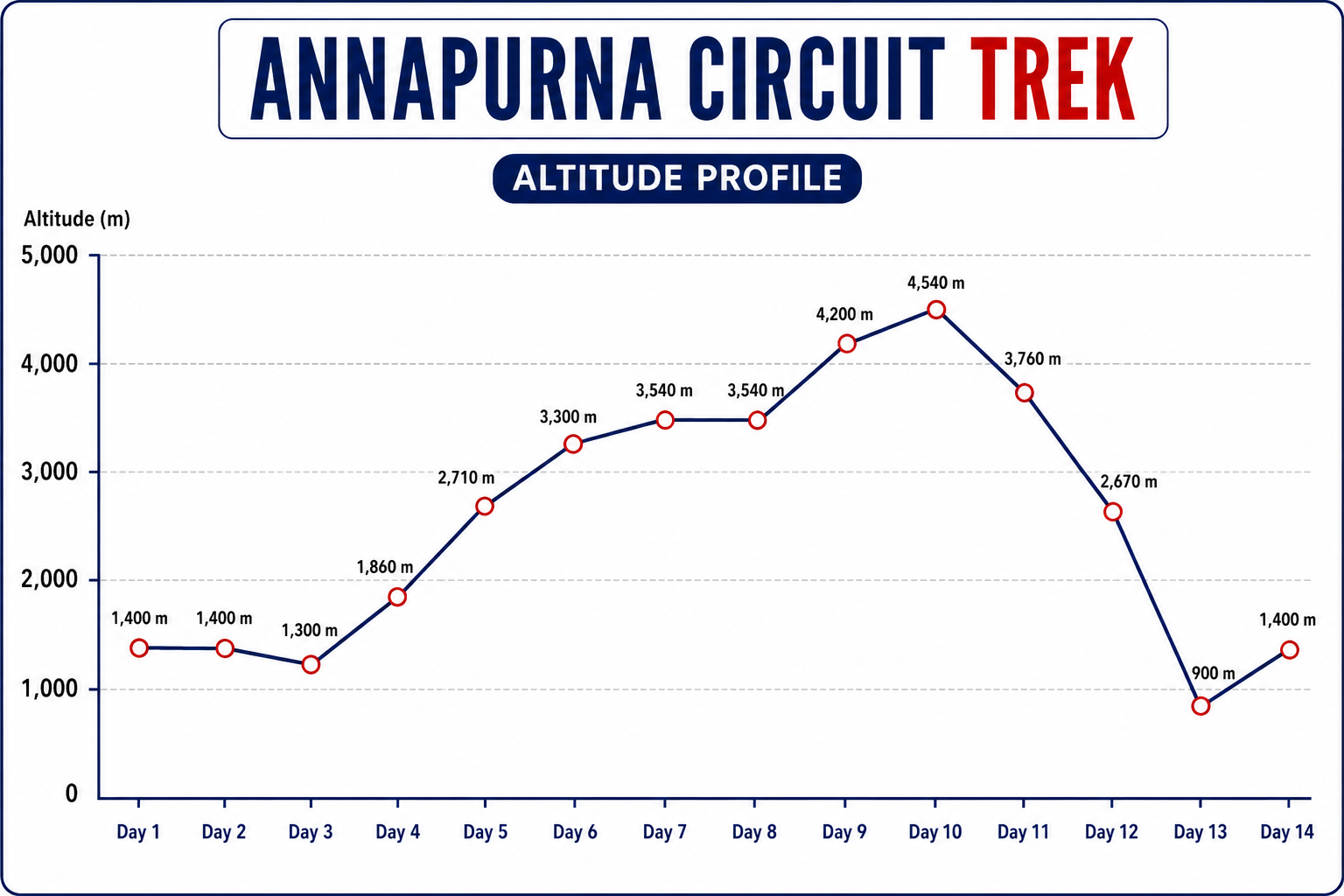
Altitude Profile
Inclusions & Exclusions
What's Included
A certified guide for the Annapurna Circuit Trek.
1 Night deluxe room in a 3-star category hotel in Pokhara with buffet breakfast.
One shared high-altitude Sherpa porter for every two trekkers to carry your main backpack.
Twin-sharing mountain lodge accommodations (teahouses) during the trek.
Standard full-board meals: (13 Breakfasts, 14 Lunches, and 13 Dinners) with one main course per meal.
Public ground transportation to and from the trek as per the itinerary.
Guide and porter fees, including all their expenses.
Insurance for guides and porters as per government regulations.
Required Annapurna Circuit trekking permits.
Local taxes and documentation fees
What's Excluded
Cost Details
Includes
A certified guide for the Annapurna Circuit Trek.
1 Night deluxe room in a 3-star category hotel in Pokhara with buffet breakfast.
One shared high-altitude Sherpa porter for every two trekkers to carry your main backpack.
Twin-sharing mountain lodge accommodations (teahouses) during the trek.
Standard full-board meals: (13 Breakfasts, 14 Lunches, and 13 Dinners) with one main course per meal.
Public ground transportation to and from the trek as per the itinerary.
Guide and porter fees, including all their expenses.
Insurance for guides and porters as per government regulations.
Required Annapurna Circuit trekking permits.
Local taxes and documentation fees
Excludes
Transfers and meals in Kathmandu.
Guided tour in Kathmandu, including monument entrance fees.
Hot and cold table drinks (tea, coffee, and beverages) and bar bills.
Hot showers and hot water during the trek.
Personal expenses (laundry, phone calls, internet).
Personal travel insurance and equipment.
Emergency rescue operation charges.
Tipping your guide and Porter.
Equipment List
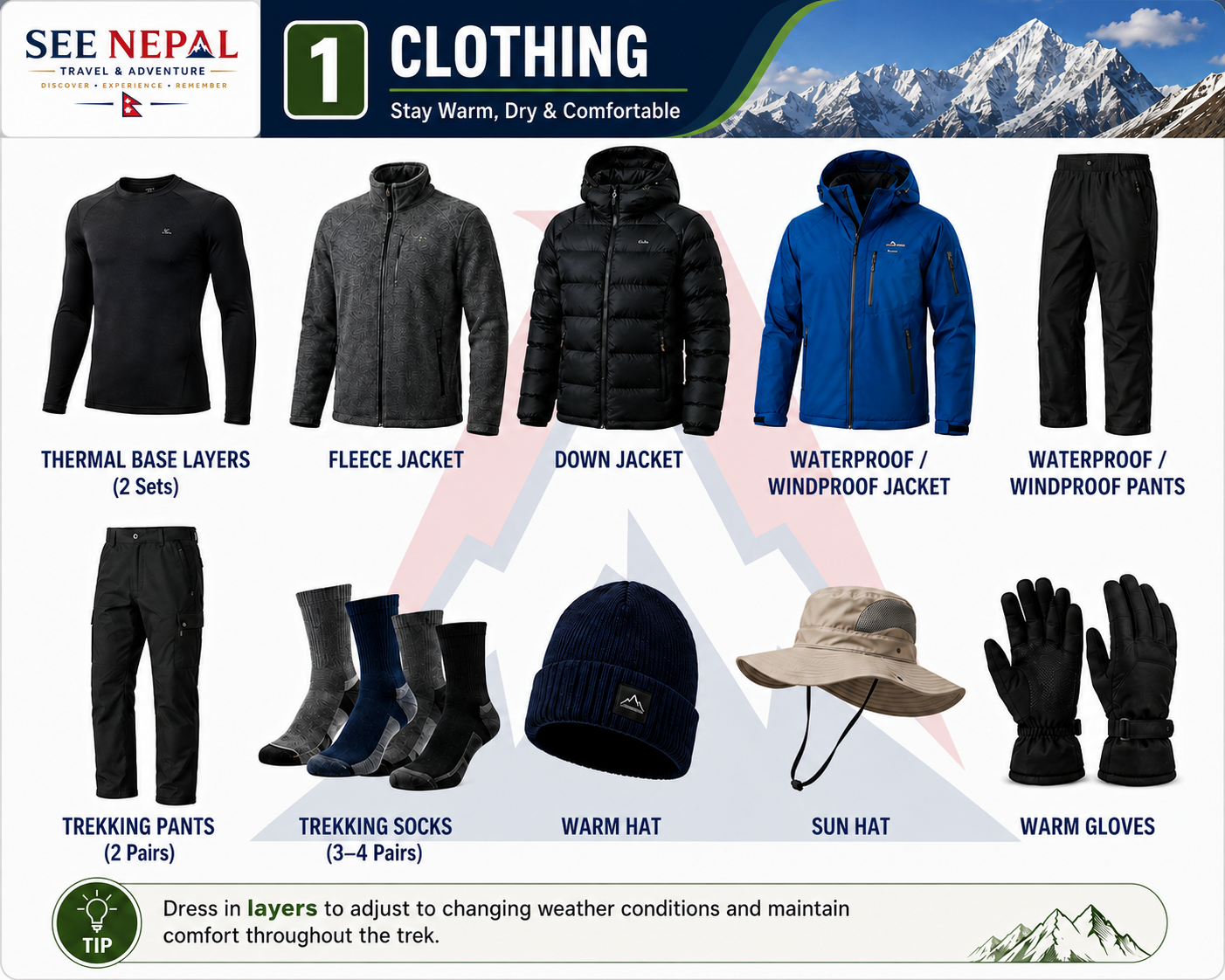
Clothing
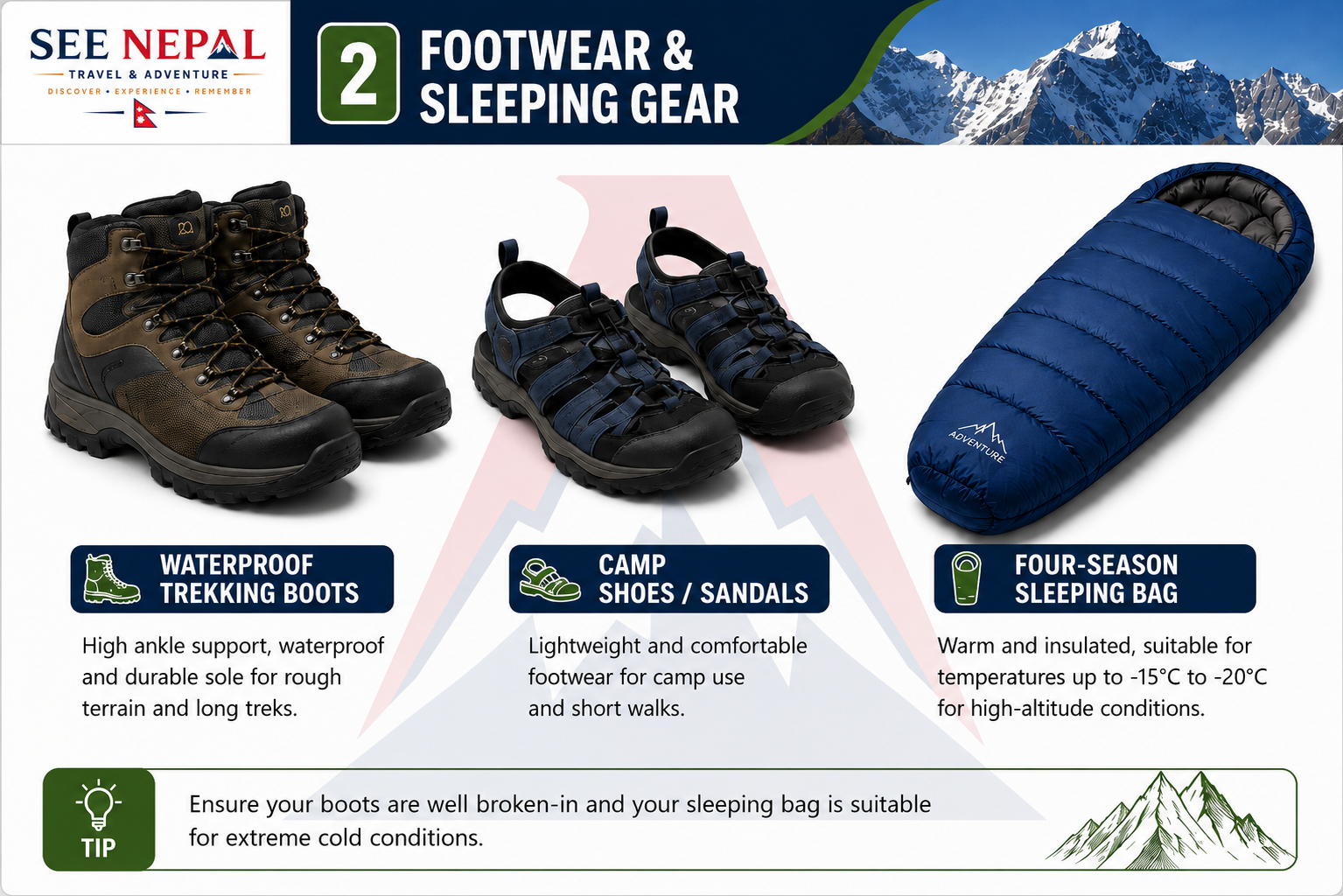
Footwear & Sleeping Gear
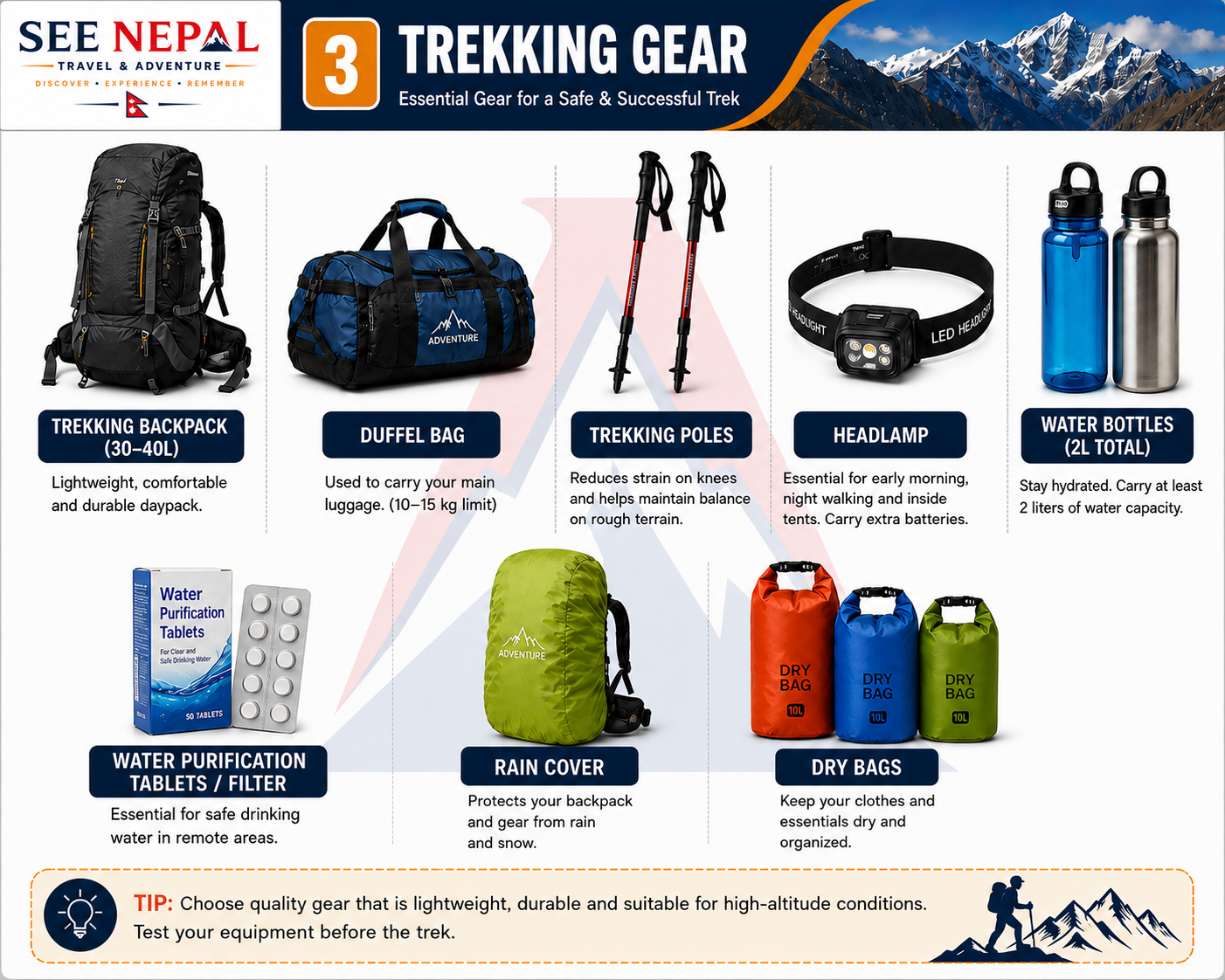
Trekking Gear
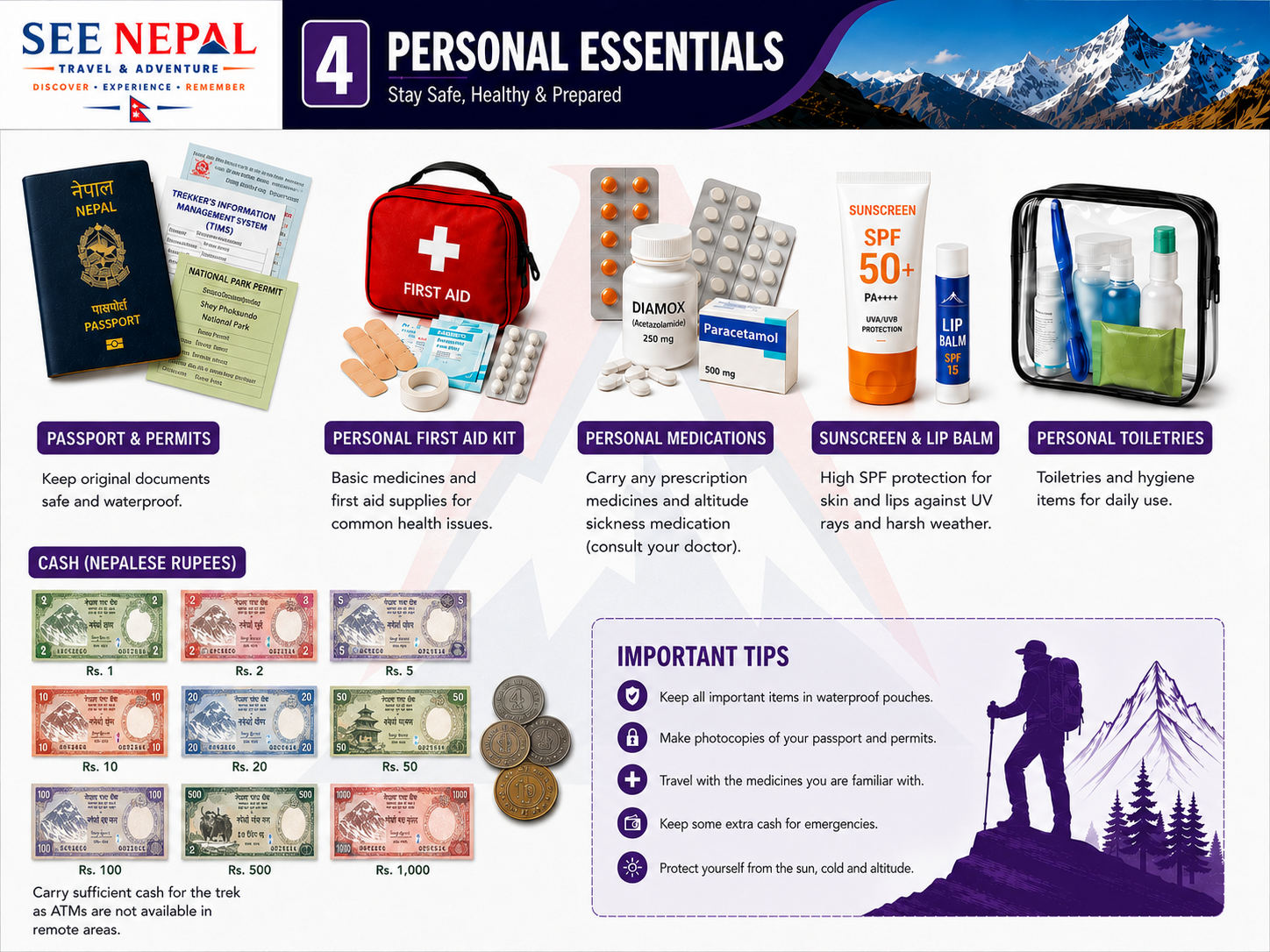
Personal Essentials
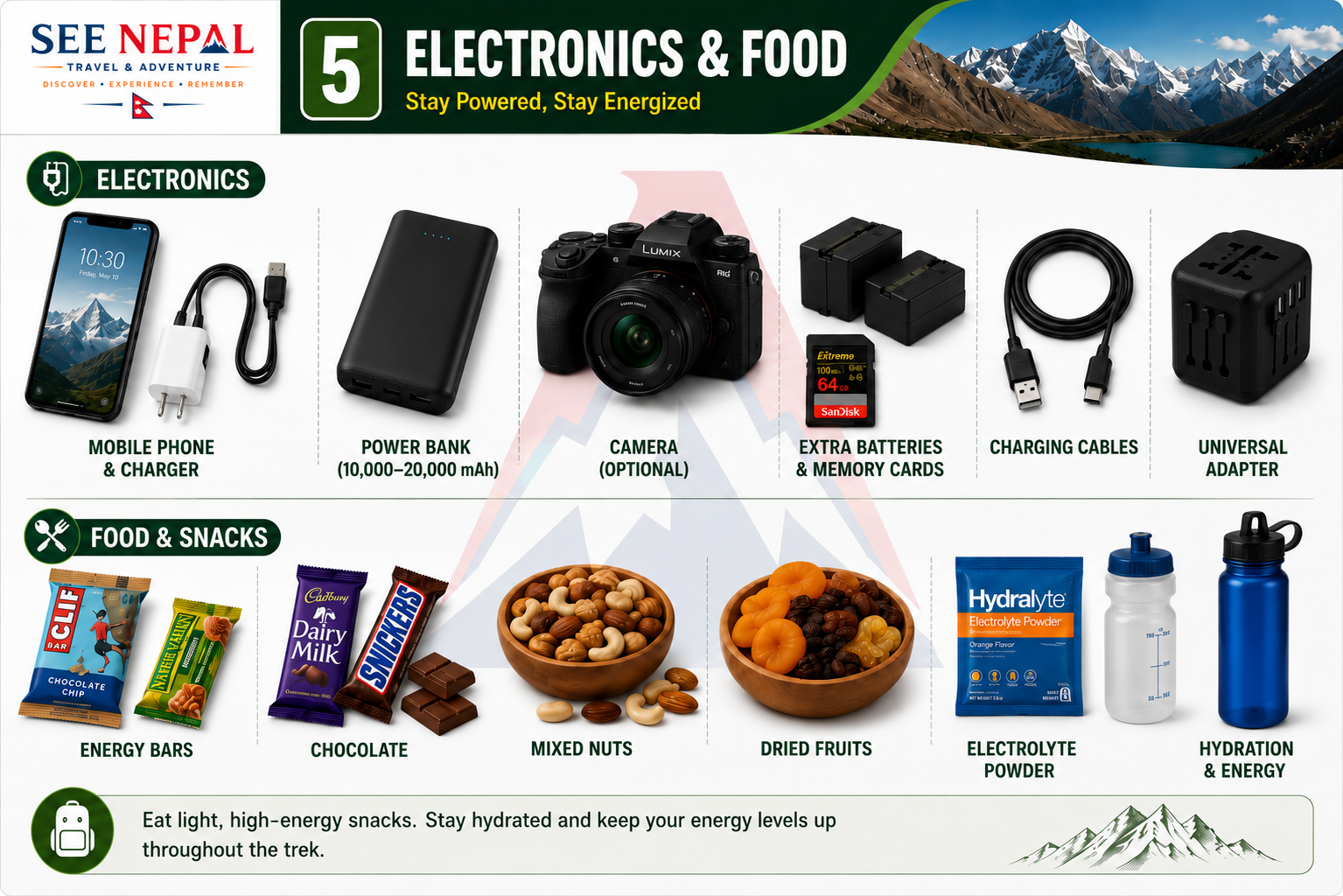
Electronics & Food
Frequently Asked Questions
The best time to trek to Annapurna Circuit is just after the monsoon is over in September, Nepal’s monsoon season last till end of August; sometime it last until first week of September, monsoon rain clears up all the dust and rainy season brings greenery in low foothill, and view of white peaks are super when we have blue sky. No snow on higher places and Throng La Pass is easily crossable. September, October and November is peak time of Annapurna Circuit trek.
Second best time to trek to Annapurna Circuit is spring (Mar to May), though there are chances of soft rain and thunder storm, sky can be hazy sometimes in lower place however there are haze in the mountains. The benefit of trekking in April and May are warm temperature or even begging of June is okay to trek to Annapurna.
Trekking in winter (December to February) can be risk of snowfall, if snowfall is heavy then pass is blocked and you may have to turn back same way down to Besisahar. It is cold in winter, the night and early morning temperature can be around negative 14 degree Celsius outside the room. In Nepal we have no certain time if snowfall in Himalaya; thus it can be anytime in dry season (October to March)
Still you need to bear in mind that climate change and global warming are affecting our world and the weather condition in Himalaya changes fast so there are chances are rain and weather turn bad even in peak seasons.
And Annapurna Circuit trek is best alternative for those having vacation in summer (June to August). Upper part of Annapurna Circuit, mostly Manang Valley and Mustang is said be under the rain shadow zone. However; monsoon rain may affect the tails and roads / bridges are washed away sometimes, so it is always wise to allow few reserve days just in case bad weather, landslides and respectively flight delays that changes your plan.
If you develop AMS (Altitude Mountain Sickness) on the Annapurna Circuit Trek, we stop at the place while line of acclimatization at 3500 m (Manang) and descend to a lower altitude immediately if he symptoms do not disappear. Symptoms range from mild (headache, fatigue) to severe (vomiting, confusion, fluid in lungs or brain), and untreated AMS can be fatal. In this case, an immediate rescue must be arranged. All clients under ranking this Adventure with us should bring Travel Insurance that should cover air evacuation and medical treatment.
In the Annapurna Circuit Trek, there is WiFi internet in most of the teahouses along the route. The internet is slow and unreliable, and the mobile network becomes weak and unavailable sometimes, but surely, you can send text messages. NTC Sim is suggested if you consider carrying a local SIM.
Absolutely, you can rest sleeping bag and a down jacket in Kathmandu. Even buying gears is may be cheaper in Nepal compared to your home country. There are brands like North Face to good replicas.
Tipping is not mandatory and never insists that a client tip. Gratitude and tipping totally depend on the intuition of a client. It is only expected by the guide and porters. Just for an idea, people usually tip 10 to 15 % of the total value of the trip cost.
SEE NEPAL suggests you to carry some cash in NPR (Rs) for your personal expenses that you may like to have beverages, donating in a monastery or else and even celebrate the trip successful. There are no banks and ATMS.
How difficult is the Annapurna Circuit trek? The question is raised in everyone’s mind before heading to the trip; it’s a fairly difficult trek for moderate trekkers. Trek used to start at Besi Sahar or Bulbule, but as road building has shortened the trek, thus people start the trek from Syange or Jagat. Our trek starts from Jagat, though you can drive further to Dharapani or even Koto and Thame. Starting the walk from Chame (2600 m) makes the trek shorter, but there are possible chances of altitude sickness because you have to go through 5416 meters high (Thorong La Pass). If you are fit and already acclimatized from the previous trek, then you can skip a few early days of trekking with a Jeep ride. Again, the Jeep ride is very adventurous on bumpy roads!
If you can allow the few extra days, you can add the Tilicho Lake side trip to the Annapurna Circuit Trek. Tilicho Lake is one of the main attractions of the Annapurna Circuit. The lake is situated at 4950 meters above sea level; it's one of the highest altitude lakes in the world considering the size. Similarly, Thorong La Pass, the highest point of the circuit, is considered one of the highest and widest pass in the world. Again, this trek is not for beginners and notice trekkers. If you are fit and young but have no such long-distance trekking experience in the Alps or Himalaya, pre-training like going to the gym or jugging regularly helps you to achieve the goal by starting the lower and allowing a few extra days to ensure you are well acclimatized and ready for the Thorong La pass.
The Annapurna Circuit trek typically takes about 12 to 21 days, departing from Kathmandu and driving to Besi Shahar it depending on where the transfer is used, with a stopover in Pokhara before getting back to the capital. The trail is moderate to fairly challenging and makes several river crossings over steel and wooden suspension bridges