The Everest Three Passes Trek is a challenging and rewarding journey through the Everest region of Nepal. This path is designed to provide trekkers with a more comprehensive Himalayan trip, as it is an extension of the regular Everest route and leads you through three high mountain passes and some of the most scenic places in the Khumbu Valley. You will pass by the traditional Sherpa villages, cross suspension bridges, walk along glacial valleys and experience the ever-changing mountainous views along the way.
This adventure starts with a flight to Lukla and a trail that goes through Phakding, Namche Bazaar, Tengboche, Dingboche and Chhukung. The path also slowly ascends in altitude and the trekkers are able to enjoy the variety of landscapes and culture in the Everest region. Significant acclimatization helps your body to adapt to the thinner air as you rise more into the mountains. The trip will involve crossings of Kongma La Pass, Cho La Pass and Renjo La Pass that have different experiences and a feeling of pride.
To most trekkers, the climax of the Everest Three Passes Trek with Everest Base Camp is the fact that they would have reached the base of the tallest mountain in the world. The pathway ends at Everest Base Camp (5,364 m / 17,598 ft), where you may stand next to the well-known Khumbu Glacier and see the spectacular Khumbu Icefall. The early morning hike to Kalapatthar (5,545 m / 18,192 ft), one of the best views of Mount Everest and the additional mountains, is another experience that one will not forget.
Another dimension to the journey is the beautiful Gokyo Valley, which is part of the route. The Everest Three Passes and Gokyo Lakes Trek will take you to the Gokyo Lakes of turquoise Gokyo Ri and Gokyo Ri (5,357 m / 17,575 ft). The panoramic views of the Himalayas can be seen on the horizon at the summit, with some of the mountains being above 8,000 meters. These scenic sites transform the trek into more than just an trek to the Everest Base Camp.
The trek is ideal for physically fit travelers with prior hiking experience and willing to spend days walking long distances and at high altitudes. The mix of mountain passes, untamed valleys, cultural experiences and renowned viewpoints makes it an experience to remember. Third Eye Adventure enables the trekkers to explore this wonderful region with ease and safety with proper planning, expert guidance, and dependable support along the way.
Highlights
Traverse the three well-known high passes of Kongma La, Cho La, and Renjo La
Arrive at Everest Base Camp (5,364 m / 17,598 ft), the base of Everest trek
Take a hike at sunrise to Kalapatthar (5,545 m / 18,192 ft) to have the best views of the mountain
Explore the stunning Gokyo Lakes with Himalayan mountains
Hike Gokyo Ri (5,357 m / 17,575 ft) to see all the mountains
Take a journey through classic Sherpa villages such as Namche Bazaar, Tengboche and Thame
Hike with glaciers, rivers, forests, and rocky mountainous terrain
Explore the natural Sagarmatha National Park
Witness spectacular mountains like Everest, Lhotse, Ama Dablam, Makalu and Nuptse
Take a full Everest circuit which includes high passes, Everest Base Camp and Gokyo Valley
Itinerary (21D, 20N)
Nepal Intrepid Treks will be your dedicated travel companion until you return to your home country. Once you arrive at Kathmandu airport, we will be there to pick you up and take you to your hotel. Accommodation for our valued customers includes room and breakfast in a three star hotel in Kathmandu.
Take in the impressions of Nepal as we drive you from the airport to your hotel. We will assist you with the check-in and provide you with further information regarding your Everest Base Camp Trek. You may then have a rest or stroll through the bustling, colorful streets and alleys of Kathmandu.
Before starting your trekking journey, we have set aside a day in Kathmandu to help you learn about the unique art, culture, and architecture of Nepal. You will be guided to the UNESCO-listed heritage sites in Kathmandu. First, you will be escorted to Kathmandu Durbar Square, where you can visit the museum, palace, its premises, and the temples built around it. Next, you will be escorted to the monkey temple – Swayambhunath. We walk up the stairs to the stupa. From the height, we can get an excellent view of Kathmandu city. Then, we visit a popular Hindu temple – Pashupatinath temple and head towards the largest stupa in the world – Boudhanath stupa. In the evening, we return to our hotel for an overnight stay.
An early flight from the domestic terminal of Kathmandu airport will take you to the Lukla airport. The flight to Lukla is a thrilling experience owing to the dramatic location where this airport is placed. During the flight, you will be able to get some stunning views of mountains arranged like a row of thorns from the windows of the plane.
Once you reach the Lukla airport, you will step into the Khumbu region of Nepal, which treasures the highest peak in the world – Mt. Everest. Lukla is nothing but an airport and a few guesthouses around. From Lukla, your guide will lead you through a trail that takes you to Phakding. At first, we descend to the Dudhkoshi River and then cross a suspension bridge over the river. Then we continue through the well-paved path to Phakding. Phakding is a small village in the Khumbu region of Nepal, and our stopping point for the day.
Overnight stay at a guesthouse in Phakding.
Leaving Phakding, we follow the trail that undulates up and down through some villages and rhododendron forests to Namche. We enter Sagarmatha National Park and walk to a village named Jorsale, from where we follow a river. We cross a suspension bridge over two rivers today and pass another village called Monjo. From Monjo, we walk uphill for around three hours to Namche.
Namche Bazaar is a popular place in the Khumbu region. It used to be a trading capital for people residing there and Tibetan people in the ancient area. Even now, it is a happening place in the Khumbu region with many shops, stalls and nice hotels. If you want to buy anything, you can find it here. Namche Bazaar is also the only way to Everest Base Camp; therefore, it is also known as the Gateway to Everest.
Today, we stay at a guesthouse in Namche for the night.
With the rise in elevation, acclimatization becomes a must. Therefore, we spend our day acclimatizing in Namche. In the morning, we set off for a hike to the Everest View Hotel. It is a vantage point in the Everest region that offers some stunning views of mountains in the Rolwaling range like Mt. Everest, Mt. Ama Dablam, Mt. Thamserku, Mt. Lhotse,Mt. Nuptse and many more.
On the way to Everest View Hotel, we come across Syangboche airport and on our return journey from the hotel, we visit a museum and photo gallery.
In the evening, we return to our guesthouse in Namche for an overnight stay.
Moving ahead with our journey, we walk towards Tengboche. Tengboche is not just popular for the stunning views of the mountains it offers, but also for an artistic monastery built here. The trail today goes uphill and downhill, therefore quite tiring, but the majestic views of Mt. Everest and other peaks in the Rolwaling range like Mt. Lhotse, Mt. Nuptse, Mt. Thamserku, and Mt. Amadablam will keep you going.
We walk across the pine and rhododendron forests and pass some pastures with yak herders to Tengboche, which will be our halting point for the day.
Overnight at a guesthouse in Tengboche.
We wake up early in the morning and walk around the Tengboche monastery for the close of views of mountains in the Everest region. We pay our visit to the monastery and set off for our journey today. We slowly descend to the village of Deboche.
We further walk through the beautiful forests of rhododendron and conifers and cross a bridge over Imja Khola to Pangboche. As we walk through, we come across the path adorned with mani stones and prayer flags. As we reach Dingboche, we can get a very close view of Mt. Ama Dablam. We will feel as if the mountain is stuck up just above us.
We stay at a guesthouse in Dingboche for the night.
As we go up, the air in the atmosphere gets thinner and thinner, which makes acclimatization a must. Therefore, we spend our day in Dingboche to adapt ourselves to the elevation gain and make ourselves ready for our journey ahead.
Today, we hike up to Nangkar Tshang Hill that rises at a height of 5100 meters, offering some spectacular views of mountains in the Everest region. The hill offers magnificent views of Island Peak, Mt. Ama Dablam, Mt. Lhotse, Mt. Makalu, Mt. Nuptse and many others.
After this beautiful hike up the hill, we descend to our guesthouse in Dingboche for the night.
Today’s trek takes us to Chhukung, a steady, moderate climb lasting just over three hours. Chhukung serves as an ideal base for an overnight stay, providing the perfect environment to prepare for the Kongma La Pass, the highest pass of our trekking.
Additionally, as the last outpost of teahouses, it is the crucial staging point for climbers preparing to ascend Island Peak, one of the most popular trekking peaks in the Everest region
Stay overnight in Chhukung.
Leaving Dingboche, we head towards Lobuche, our destination for the day. We continue our walk through the valley floor to Dugla. As we step forward, we will slowly leave the Khumbu glacier behind us. On the way to Lobuche, we will find the cemetery of the climbers who lost their lives during their attempt to climb Mt. Everest.
We can feel the air in the atmosphere getting thinner and thinner as we move by. We have to be careful not to overexhilarate ourselves at this critical point of our journey. At Lobuche, we will be blessed with the splendid views of Mt. Pumori, Mt. Lingtren, Khumbutse and Mahalangur. As we cross the Khumbu glacier, the beautiful peak of Nuptse also comes to our sight.
Overnight stay at a guesthouse in Lobuche.
Today is the most important day of your journey, as you will come across your ultimate dream of standing in front of Mt. Everest in the Everest Base Camp. Leaving Lobuche, we head towards Gorekshep with the views of the northern ridge of Everest along with Mt. Pumori, Mt. Lingtern, Mt. Khumbutse, Mt. Nuptse, etc. As we walk down to ThangmaRiju, we will be blessed with a 360-degree view of snow-clad mountains.
We then climb up steeply through the Changri glacier, where Kalapattar comes to our sight! We continue walking until we reach Gorekshep. As we reach the place, we can see mountains all around us. The towering peaks standing right in front of us, one after another, our eyes will wander where to look! The moment is truly the moment of our life as we will be standing on the Everest Base Camp, the dream of ultimate adventure lovers, the top of the world. After accomplishing our goal of being on the base camp, we retraced our steps back to Gorekshep.
Overnight stay at a guesthouse in Gorekshep.
From Dingboche, we ascend to Chhukung. We walk for around three hours, enjoying the pastures and views of the Himalayas all around us. And after reaching Chhukung, we will take a rest or hike to Chhukung Ri. We spend our night at a guesthouse in Chhukung. (Breakfast, lunch and dinner included).
We wake up before the sun and head towards Kalapttar for the views of a glorious sunrise over the white, snowy mountains. The view of the mountains as the first light of the sun illuminates over the mountains is fascinating. The hike to Kalapattar can be an awesome experience for all the photographers who would love to save the memories with nature. After beholding the memories of the mountains, we descend to Gorekshep and then to Lobuche.
From Lobuche, we head to Dzongla with beautiful scenery of Mt. Aamadablam, Taboche, Cholatse and Lubuche peaks.
Overnight stay at a guesthouse in Dzongla.
Today’s trek is a major highlight of the journey, offering an adventurous crossing of the high-altitude Cho La Pass. We begin by walking along a relatively flat, stone-paved path before transitioning into a dry, barren valley. The terrain soon becomes steep as we ascend toward the pass.
The Cho La Pass itself is a dramatic, icy trek along the edge of the glacier, demanding careful footwork but providing stunning views of the surrounding Himalayan peaks. Upon reaching the summit, we are rewarded with breathtaking panoramas of the Khumbu region, including Cholatse, Ama Dablam, and Lobuche.
After enjoying the momentous top, we begin a long, steep descent through rocky, scree-covered paths to Phedi. Following the trail further, we descend into the small settlement of Thagnak (also known as Thangna), where basic, warm tea houses provide much-needed rest. The area offers spectacular views of the rugged landscape, including the Machhermo peak and neighboring summits.
Spend you night at a teahouse in Thangna.
Today, the itinerary features a scenic trek along the edge of the Ngozumpa Glacier—the longest glacier in the Himalayas—as we make our way toward the first of the breathtaking Gokyo Lakes.
The route is relatively straightforward, following a gentle, flat path along the Dudh Koshi River valley, allowing for a steady ascent to the Gokyo settlement.
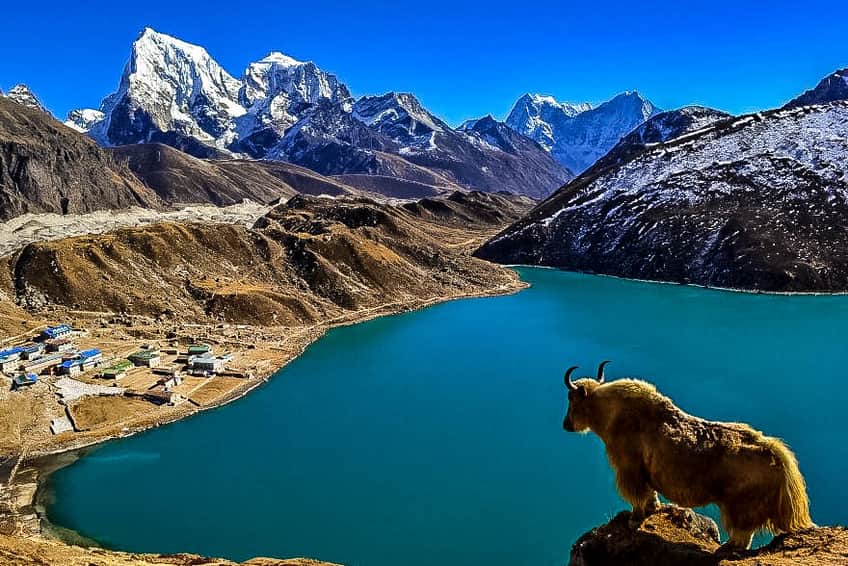
Upon arriving at Gokyo, you will be welcomed by the awe-inspiring beauty of Dudh Pokhari (the third lake).
Surrounded by high-altitude peaks, these pristine turquoise waters are nestled between the massive terminal moraine of the Ngozumpa Glacier and the Gokyo village settlement, offering a truly surreal and tranquil Himalayan atmosphere.
Spend your night at a teahouse in Gokyo Lake.
We spend the day admiring the beauty that resides in the azure lakes at Gokyo. Early in the morning, we hike up to the Gokyo Ri. Our climb up to Gokyo Ri is strenuous, as it is a steep climb for around 3 to 4 hours. But the fascinating scenery of Gokyo village that lies on the edge of the third Gokyo Lake and the views of Ngozumpa glacier will keep you going.
The experience of being surrounded by the mountains like Kusum Kanguru, Lhotse, Thamserku, Makalu, Kangtega, Nuptse, Taboche, Cholatse, Changtse, and Pumori is rejoicing. The view of sunrise above the Mt. Everest is a memorable sight to be preserved. After our climb up the Gokyo Ri, we descend to Gokyo.
Overnight at the guesthouse in Gokyo Valley.
Today’s journey begins on the northern edge of Gokyo village, tracing the tranquil shores of the Dudh Pokhari (Gokyo Lake). Following the lake, the trail transforms into a steady, steep ascent, navigating rocky terrain and stone steps built into the hillside.
Upon reaching the summit of Renjo La Pass, adorned with vibrant prayer flags, you are rewarded with unparalleled panoramic views of the Everest range, the Gokyo Valley, and the remote Bhote Koshi Valley. The descent into the Bhote Koshi Valley is steep and often slippery, leading through a secluded, untrodden landscape to the quiet, rustic settlement of Lungden.
Spend your night at the teahouse in Lungden.
Today we retraced our journey back to Namche. The journey starts by following the Bhote Koshi River downhill, walking through yak pastures and small, traditional Sherpa villages. The landscape is initially barren and rocky, offering a quiet, remote experience before rejoining more developed trails.
A notable stop, Thame holds a famous monastery and offers a lunch break. The trail passes a large white stupa overlooking the village, providing a scenic spot for photos
After Thame, the trail continues to descend along the river, crossing it at times. As you approach Namche, the scenery transitions from alpine to pine and rhododendron forests, becoming lusher as you arrive in the bustling town of Namche Bazaar.
Spend your night at the teahouse in Namche.
We continued our journey back to Phakding via the same path, and further until we reached Lukla. The Dudh Koshi River, suspension bridge and the lush landscape are reverse flashbacks of the trail you took earlier on.
Only this time you walk it with the knowledge that you are one of the fortunate people who reached Everest Base Camp.
Spend your night at the teahouse in Lukla.
Today you bid a goodbye to the Khumbu region of Nepal. After so many highlights, such an exhilarating experience and so much beauty this region has shown you, you will take a flight back to Kathmandu from Lukla airport.
Upon your arrival, you will be escorted to your hotel in Kathmandu. The rest of the day is at your convenience, whether you want rest or just wander around.
Overnight stay at the hotel (breakfast included)
Spend this day at your leisure in or around Kathmandu. You can take one of our optional day trips, relax or roam around Kathmandu city. Perhaps go for a massage – you deserve it – or do some last-minute shopping.
Take a leisurely lunch in one of the many tea gardens or dine on one of the rooftop terraces. Overnight stay at the hotel (breakfast included).
After this wonderful adventure, it’s finally time to bid you farewell. We will pick you up from the hotel and escort you to the airport for your journey home! We hope with all our hearts that we served you well and look forward to seeing you or your friends again someday.
Namaste!
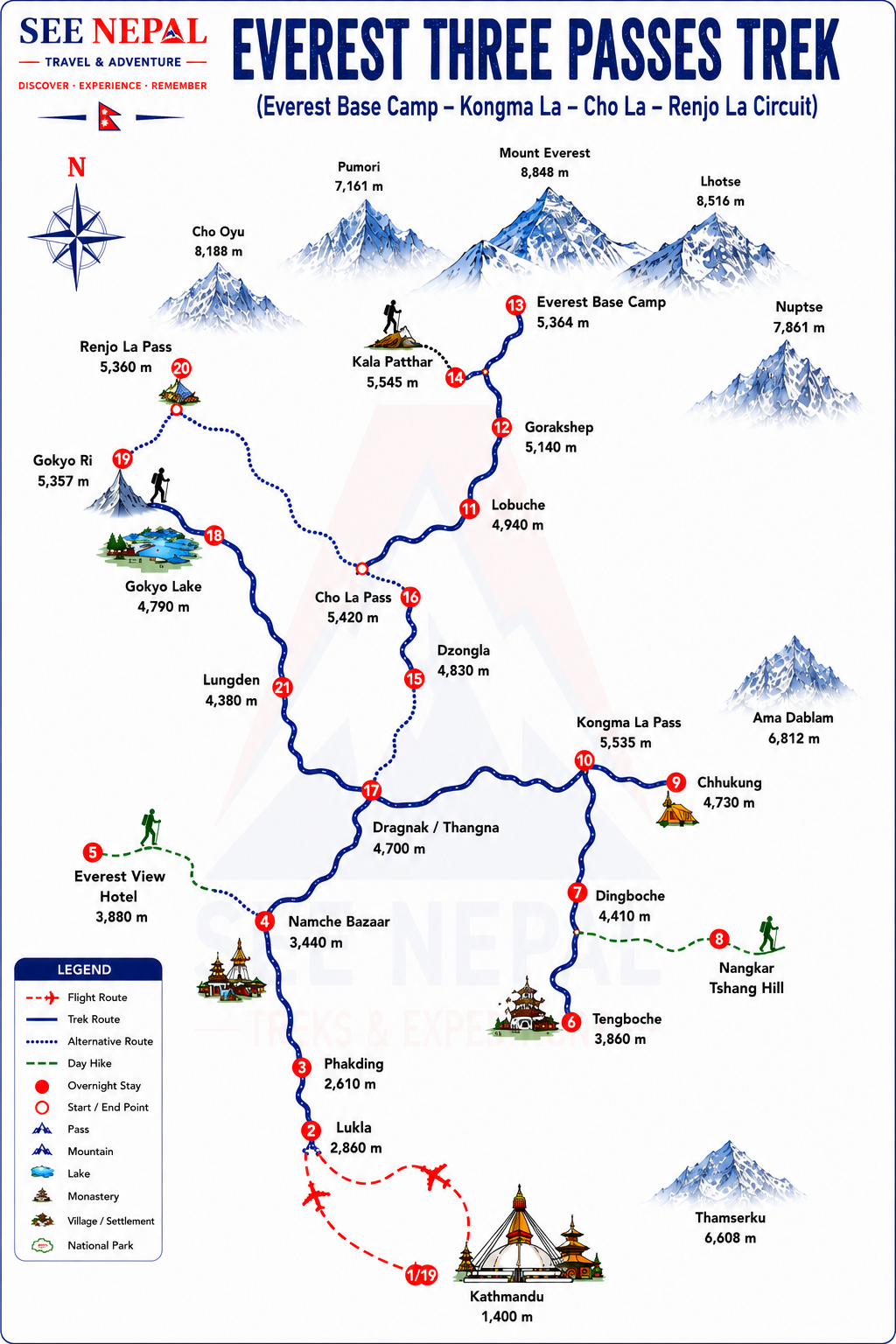
Trekking Map
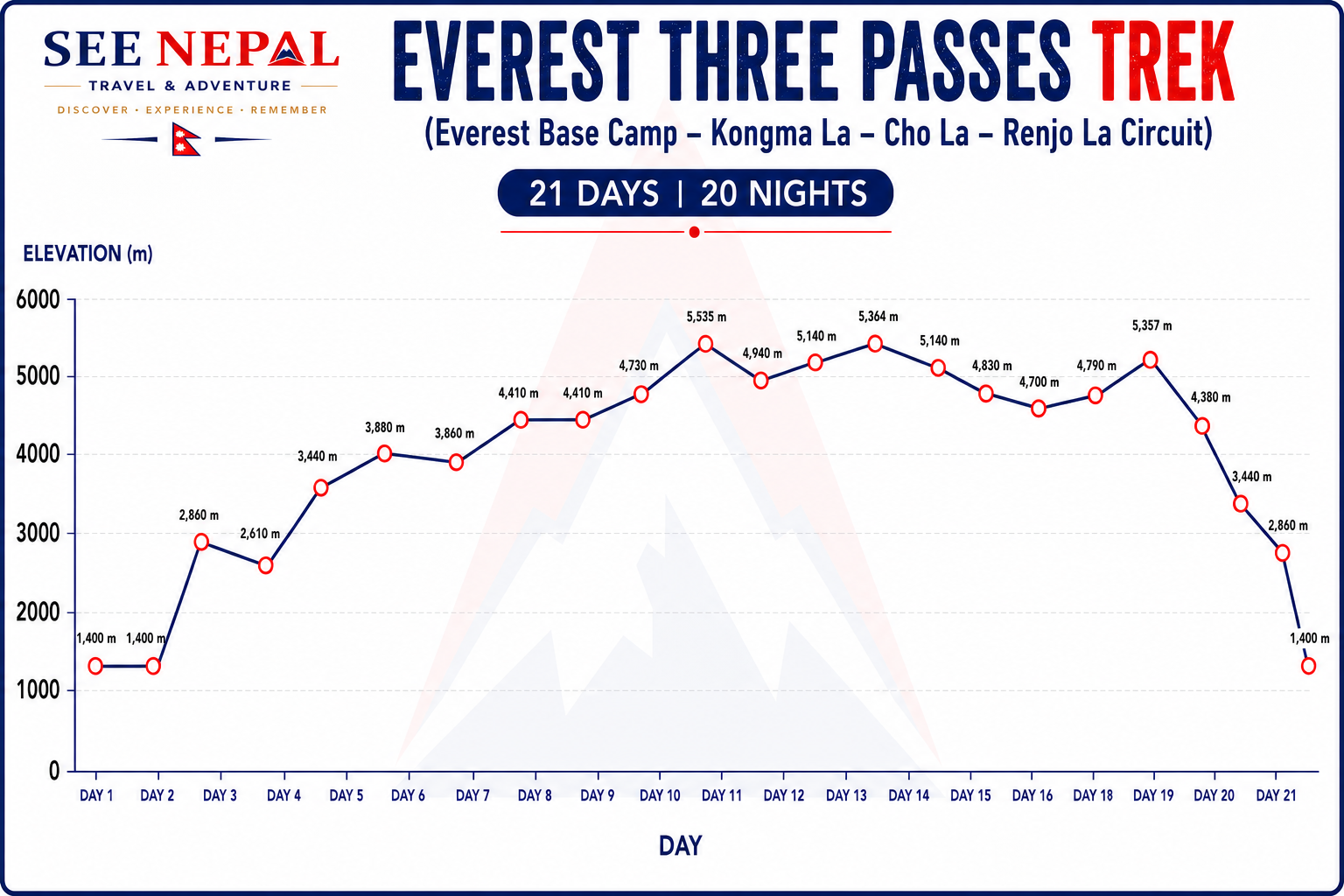
Altitude Profile
Inclusions & Exclusions
What's Included
Transfers to and from the airports by personal vehicles.
Domestic flights Kathmandu-Lukla as per the itinerary.
Any necessary trekking permits and entry fees.
Accommodation in hotels in Kathmandu as mentioned in the itinerary.
Teahouse accommodation during the trek.
Breakfast, lunch and dinner daily on the trek.
Experienced English-speaking trekking guide.
Porter service required on the trek.
Guide and porter salaries, provisions, lodging, and insurance.
Extensive first aid pack, which is carried by the guide.
Taxes by the government and formal charges.
What's Excluded
Airfare to and from Nepal.
Entry visa in Nepal.
Travel insurance and emergency evacuation insurance.
Lunch and dinner in Kathmandu.
Individual walking gear and clothes.
Hot showers, charging batteries and internet charges on the trek.
Alcoholic drinks, soft drinks and bottled water.
Personal expenses such as laundry, snacks and souvenirs.
Guide tips, porter tips, and driver tips.
Any charges due to flight delays, weather, or any unexpected events.
Any services not mentioned in the section of cost includes.
Equipment List
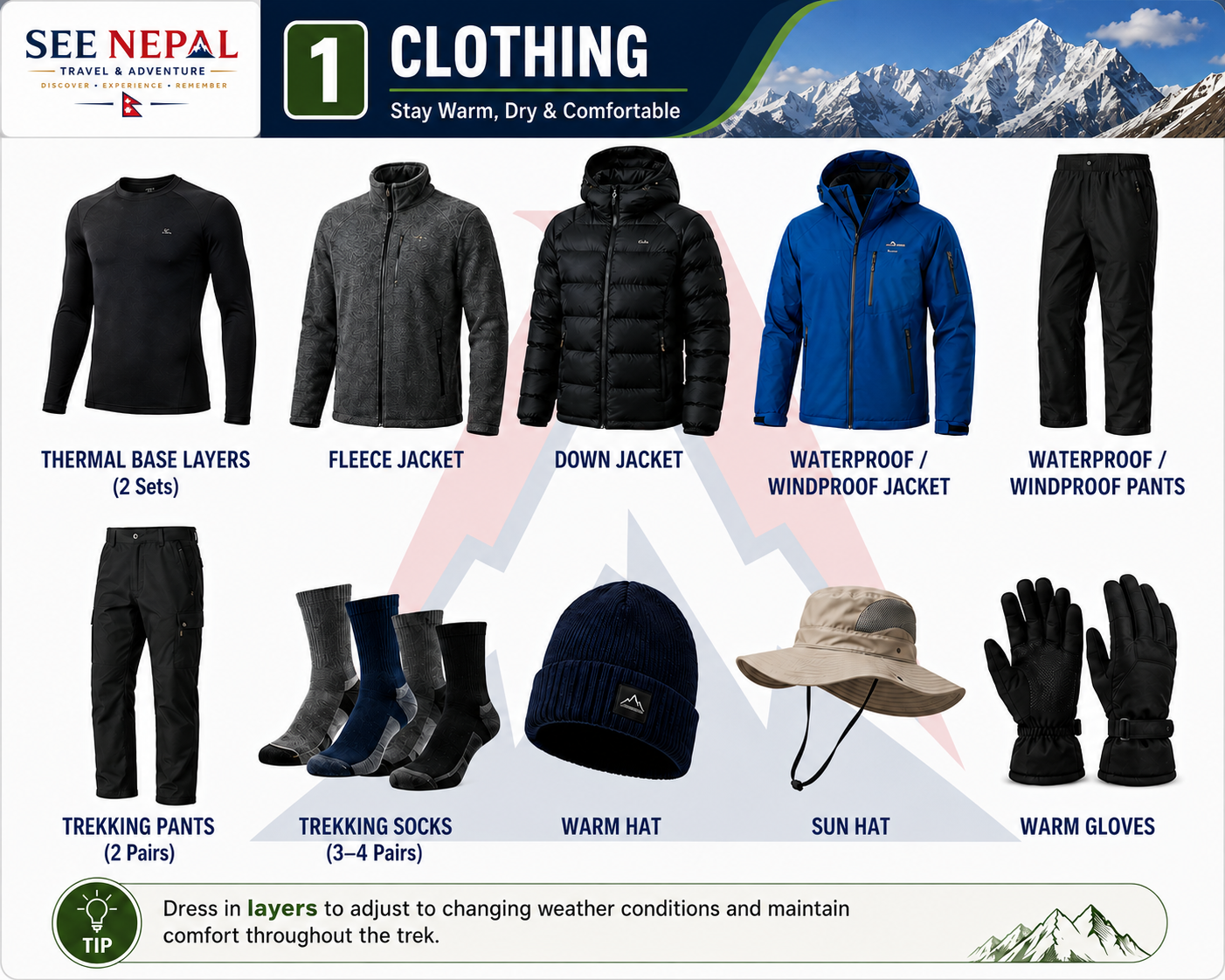
Clothing
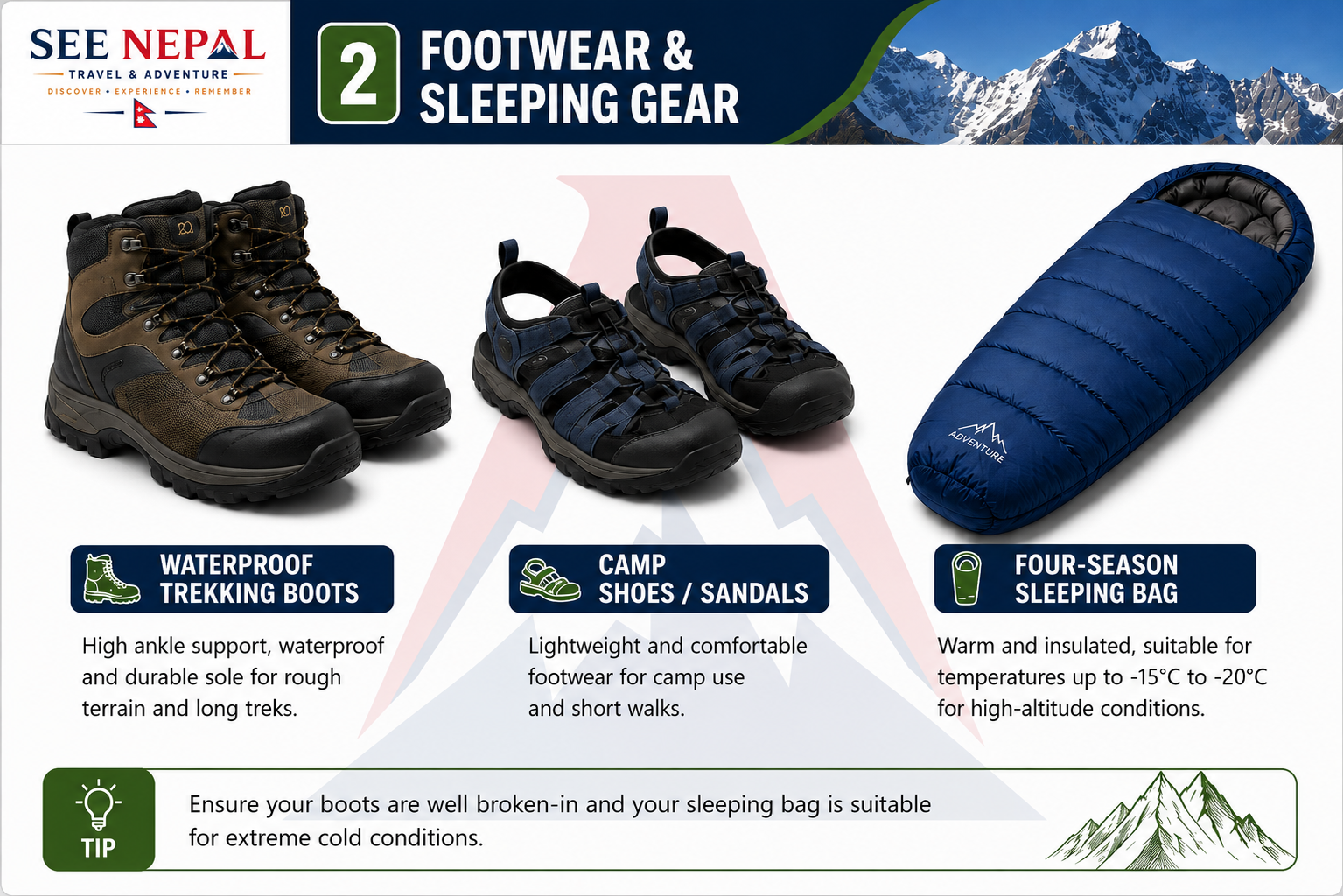
Footwear & Sleeping Gear
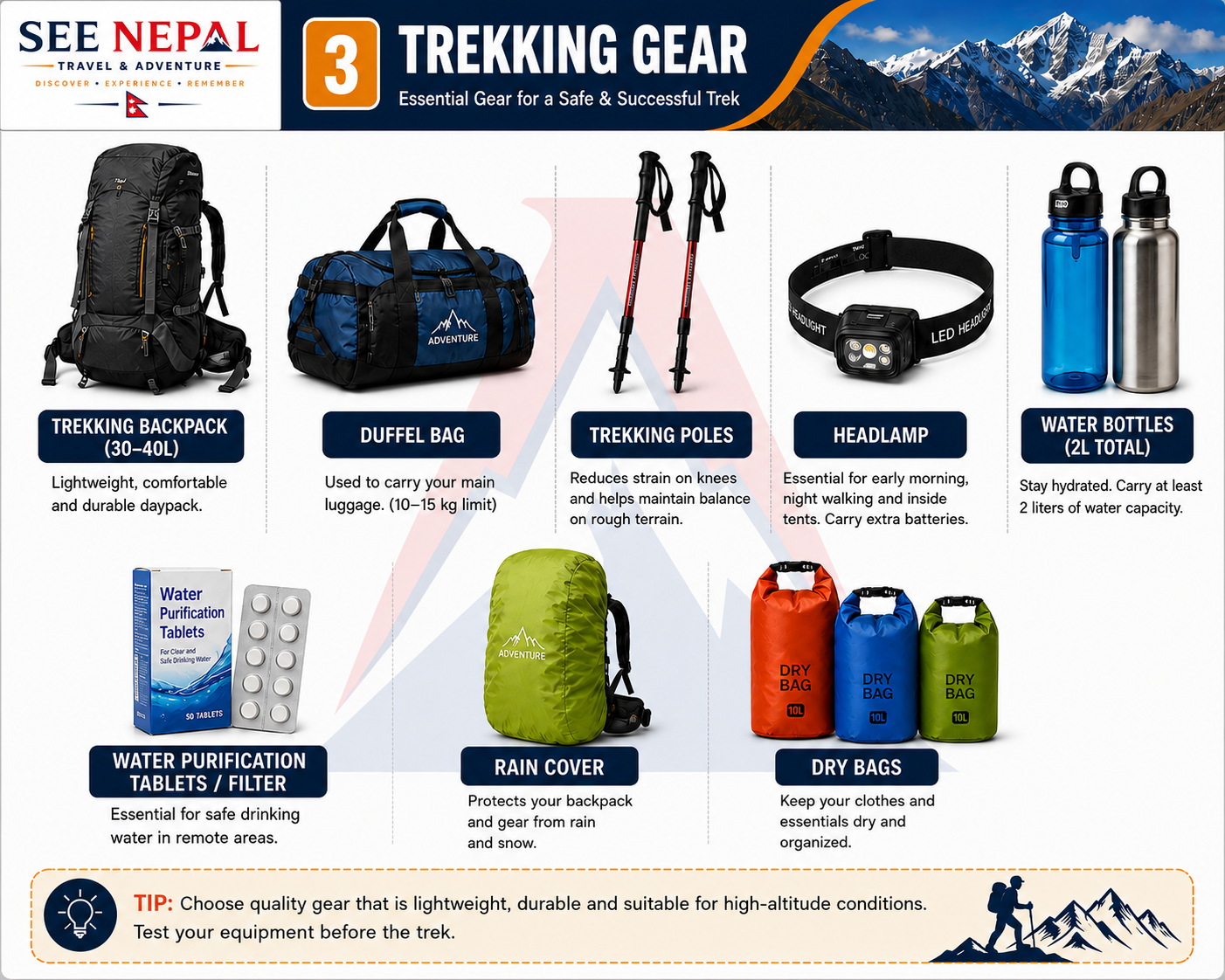
Trekking Gear
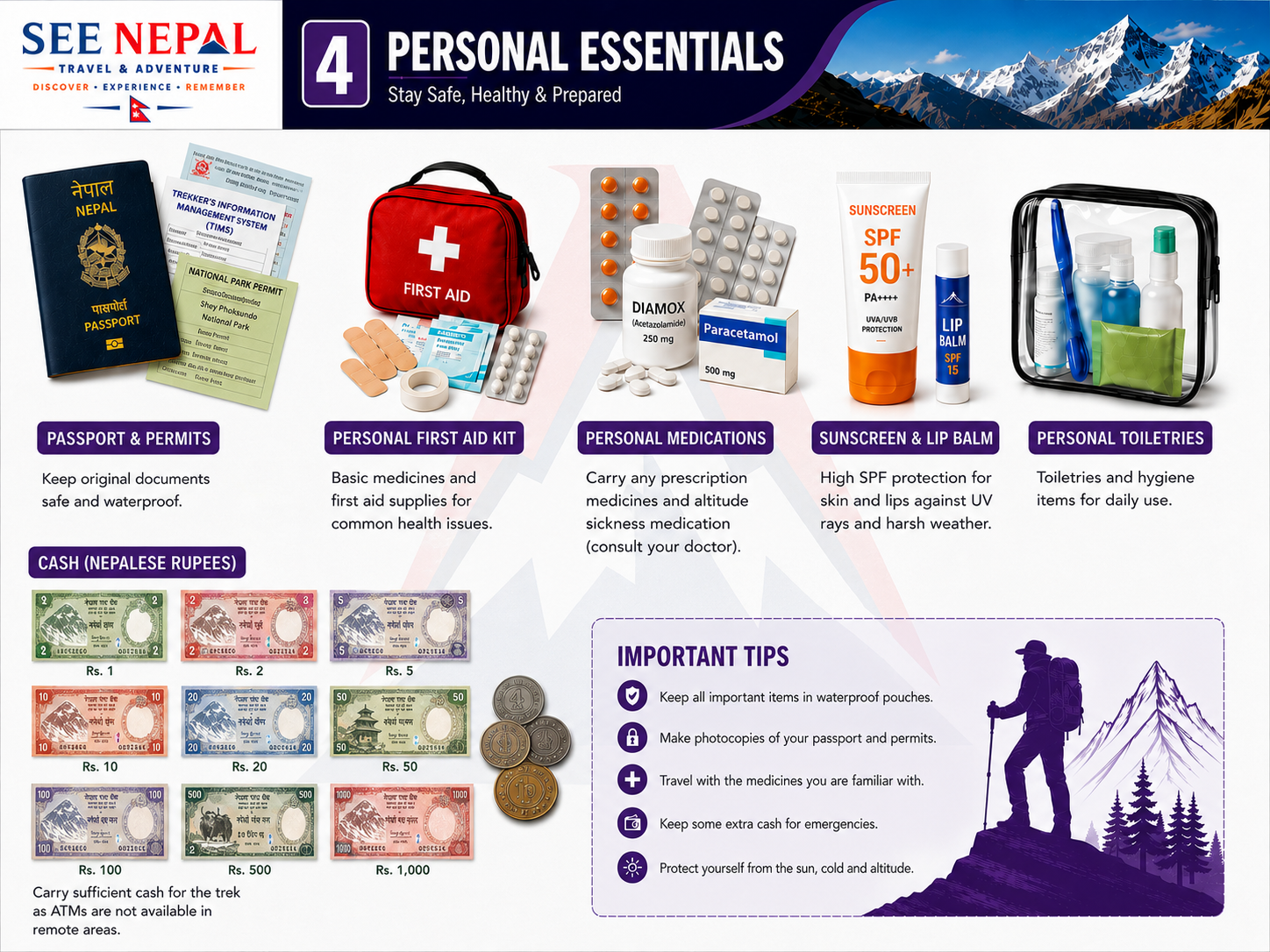
Personal Essentials
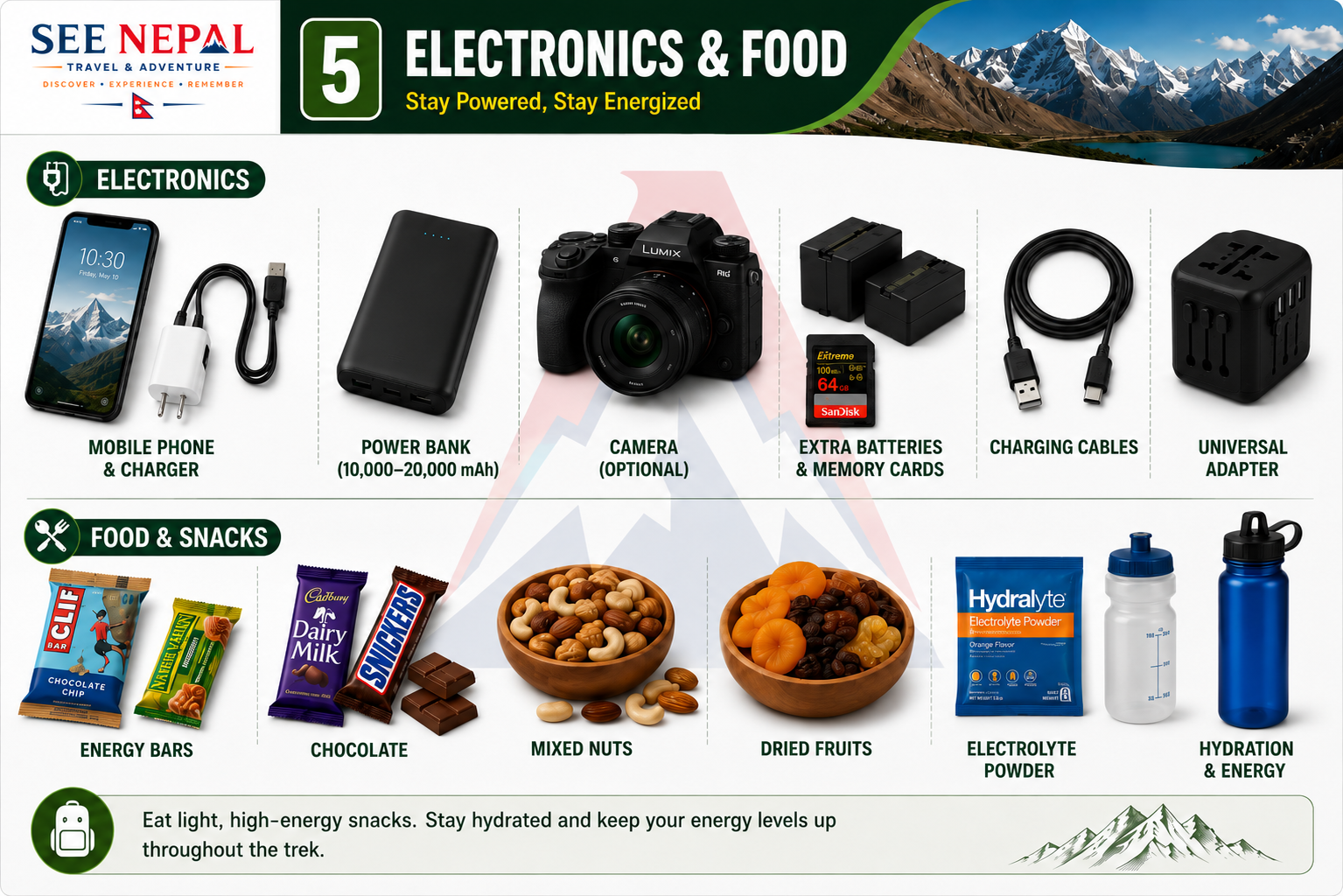
Electronics & Food
Frequently Asked Questions
The Everest High Pass Trek is regarded as one of the toughest treks in Nepal. It requires crossing three high-altitude passes, including Kongma La (5,540m), Cho La (5,420m), and Renjo La (5,360m), and demands high levels of physical fitness, stamina, and psychological endurance.
Hikers typically spend 6 to 8 hours a day in rugged terrain. Technical climbing is not necessary, but a fitting experience in high-altitude trekking is definitely recommended.
The classic Everest Three High Passes Trekking schedule is approximately 17-21 days long, depending on your pace and the number of acclimatization days, as well as optional side excursions (such as Gokyo Ri or Everest Base Camp).
The total length of the Trek is about 160 km (99 miles) to 185 km (115 miles). The distances will depend on the route you take and any side trips you may take.
This Trek is not recommended for beginners. This is the Trek that requires physical and mental stamina. Beginners should first try other shorter Treks to build experience.
You’ll need: Sagarmatha National Park entry permit (NPR 3000.00), and Khumbu Pasang Lhamu Rural Municipality Permit (NPR 3000.00).
When you book your Trek with us, all of our permits are sorted by Outfitter Himalaya
It is indeed possible to trek solo to the Everest region. Due to remoteness and a fast and furious high-altitude environment, we strongly advise that when you go on the Everest High Passes Adventure, you hire a guide or a porter to assist in reaching safety and to negotiate the right path
Spring (March-May) and autumn (September-November) are the best seasons to see the skies, and the weather is quite stable. Monsoon and winter are also suitable for long-time trekkers; however, they are accompanied by snow, cold, and unpredictable weather.
You will have teahouses/ lodges housed by Sherpa along the trail. These offer basic rooms, hearty meals, and a warm atmosphere.
Yes, most teahouses offer charging and paid Wi-Fi (USD 3-5). However, it is better to have a power bank at a higher altitude
You can get an affordable package in Outfitter Himalaya.
The cost for a fully guided 21-day Trek ranges from USD 1,500 to USD 1,900 per person, depending on the group size.
Yes, you should have previous high-altitude trekking experience and be comfortable walking 6-8 hours daily.
Our guides are well-trained in high-altitude conditions. Please inform the guide that our trek guides are equipped with altitude sickness treatment. Our itinerary includes some days of acclimatization, and we also have a stock of basic first aid supplies. In extreme cases, it may take the form of descent or helicopter evacuation (insurance is required).
Travel insurance is required to cover all trips at high altitudes (up to 6,000m) and eventual evacuation.
Essentials include:
Broken-in trekking boots (also called hiking boots)
Layers and a raincoat
Sleeping bag (-15 °C)
Trekking poles, headlamp, water bottles
Sunglasses, sunscreen, and a personal first aid kit
Detailed packing lists are also supplied when booking.
You will require top-notch fitness. Start training 6 to 8 weeks before the Trek with cardio (running, cycling), general body strength (specifically legs and core), and cardio-based hikes to help your body adjust to high altitude.
The guides are licensed and experienced, and we use reliable porters who carry your main bag (up to 12), for which an extra fee applies. You are just lugging a daypack.
The Everest region is considered safe for women trekkers. It is safe and comfortable because the safety and comfort of our guests are the ultimate goals of our professional guides and porters in charge.
Bottled water is available but expensive at high altitudes, which contributes to increased plastic waste. A refillable bottle and water purification tablet are recommended to carry.
Yes, at Outfitter Himalaya, we can customize your Trek to match your pace, schedule, and comfort