The Everest Base Camp Trek is one of the most iconic trekking routes in the world. Trekking through the Khumbu region, you pass through Sherpa villages, ancient monasteries, and stunning Himalayan landscapes before reaching the base of the world's highest mountain at 5,364m.
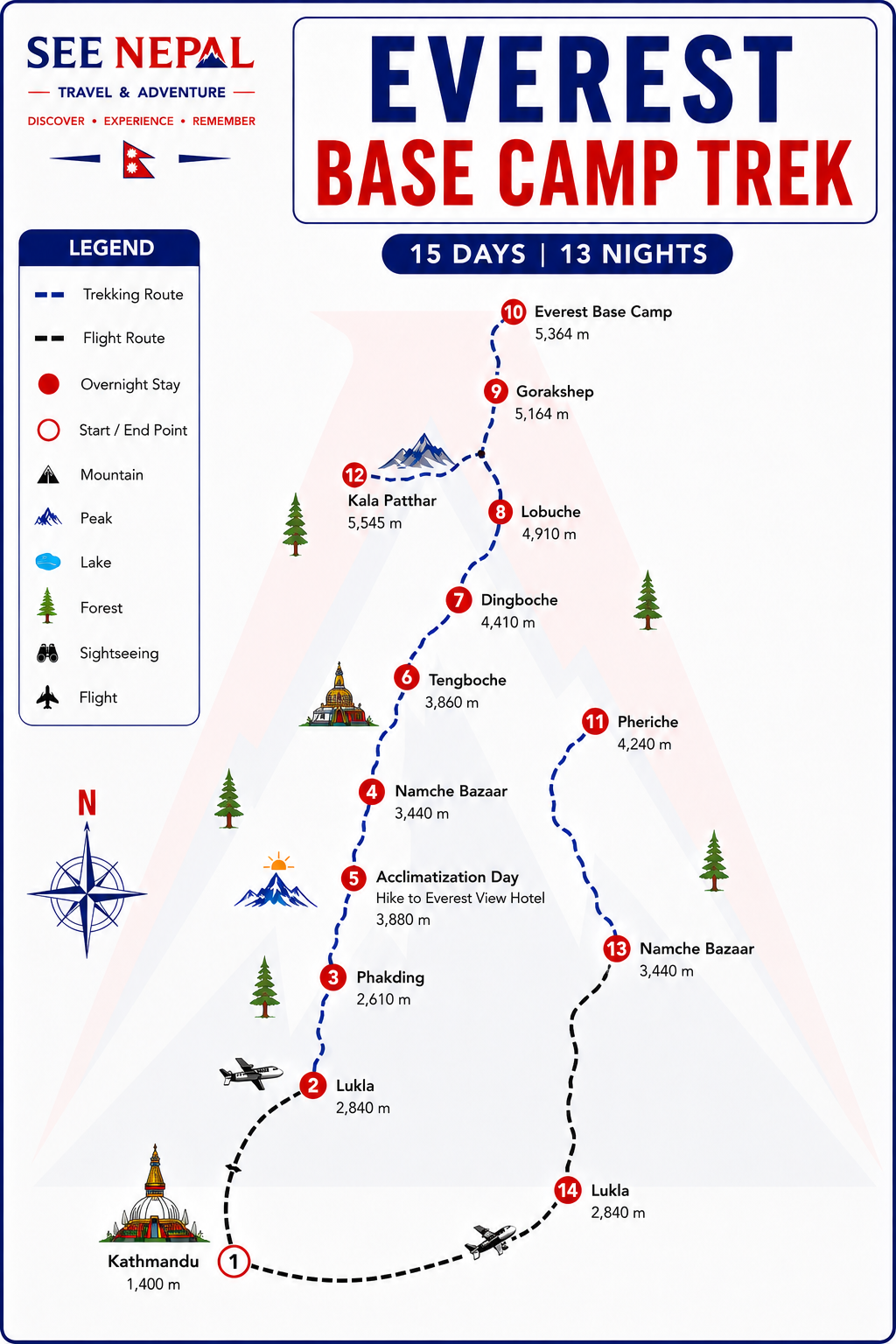
Starting from Lukla, the trail winds through Namche Bazaar, Tengboche, Dingboche, and Lobuche before reaching Gorak Shep and Everest Base Camp. The views of Everest, Lhotse, Nuptse, Ama Dablam and dozens of other peaks are simply breathtaking.
Highlights
Scenic mountain flight to Lukla, one of the most thrilling airports in the world
Walking through beautiful Sherpa villages like Namche Bazaar, the main gateway to Everest
Stunning views of Himalayan giants, including Mount Everest, Lhotse, Nuptse, and Ama Dablam
Crossing iconic suspension bridges decorated with colorful prayer flags over the Dudh Koshi River
Exploring Buddhist culture and visiting monasteries such as Tengboche Monastery
Standing at the breathtaking Khumbu Glacier and Icefall near Everest Base Camp
Sunrise panoramic view from Kala Patthar, the best viewpoint of Everest
Experiencing warm Sherpa hospitality, traditional food, and mountain lifestyle
Trekking through Sagarmatha National Park, a UNESCO World Heritage Site
Achieving the unforgettable milestone of reaching the base of the world’s highest peak
Trip Gallery
Itinerary (15D,14N)
When you land in Kathmandu, one of our representatives will warmly welcome you and transfer you to your hotel. After check-in, take some rest, or you can also explore the vibrant streets of Thamel. In the evening, we’ll also brief you about the trek, and then you can rest up and prepare for your adventure. Overnight in Kathmandu.
Before starting your trekking journey, we have set aside a day in Kathmandu to help you learn about the unique art, culture, and architecture of Nepal. You will be guided to the UNESCO-listed heritage sites in Kathmandu. First, you will be escorted to Kathmandu Durbar Square, where you can visit the museum, palace, its premises, and the temples built around it. Next, you will be escorted to the monkey temple – Swayambhunath. We walk up the stairs to the stupa. From the height, we can get an excellent view of Kathmandu city. Then, we visit a popular Hindu temple – Pashupatinath temple and head towards the largest stupa in the world – Boudhanath stupa. In the evening, we return to our hotel for an overnight stay
Early morning, having breakfast, you’ll be picked up from your hotel, and we’ll drive to Tribhuvan International Airport for our scenic flight to Lukla. It will take approximately 30-35 mins from Kathmandu. Lukla airport’s runway is one of the shortest runways in the world, as it is located at the edge of Chaurikharka hill. During the flight, you will experience one of the most thrilling flights, with stunning views of the Himalayas, including the breathtaking peaks of Mount Everest, Lhotse, and Ama Dablam.
And from Lukla, our Everest Base Camp Trek officially begins. There, we’ll meet our porters and start trekking to Phakding. The trail gradually moves down to the small village of Thado Koshi and witnesses an amazing sight of Kusum Kanguru Mountain. And crossing numerous suspension bridges to the small village of Ghat.
Finally, an easy downhill takes us to Phakding, a beautiful mountain village. It is surrounded by tall hills on the bank of the Dudh Koshi River, a valley that lies north of Lukla. Overnight at the teahouse in Phakding.
After an early breakfast in Phakding, the trek begins along the peaceful banks of the Dudh Koshi River, passing through pine forests, prayer wheels, and small Sherpa villages. The trail crosses several suspension bridges decorated with colorful prayer flags, offering the first real feeling of being deep in the Everest region. Along the way, you will pass settlements like Monjo, where the entrance to Sagarmatha National Park begins.
The route gradually becomes steeper as the trail climbs towards Namche Bazaar. One of the highlights of the day is crossing the famous Hillary Suspension Bridge high above the river gorge. On clear days, trekkers may catch their first distant glimpse of Mount Everest before reaching Namche.
By late afternoon, you arrive at the vibrant Sherpa town of Namche Bazaar, surrounded by towering Himalayan peaks, cozy cafes, bakeries, and mountain lodges. Overnight in Namche Bazaar.
After a steady ascent from Phakding, you arrive at Namche Bazaar feeling the change in altitude and rhythm of the Himalayas. The acclimatization day here is an important part of the journey to Everest Base Camp, designed to help your body adjust before moving into higher elevations.
The morning usually begins with a short but rewarding hike to nearby viewpoints such as the Everest View Hotel ridge or Syangboche. From here, you get your first clear, dramatic glimpses of peaks like Mount Everest, Ama Dablam, and other surrounding giants. After soaking in the views, you descend back to Namche for rest and exploration.
The rest of the day is relaxed, giving you time to explore the vibrant streets of Namche Bazaar, filled with bakeries, gear shops, cafes, and traditional Sherpa homes. You can also visit the Sherpa Culture Museum or simply enjoy the mountain atmosphere while your body adapts to the thinning air.
This acclimatization stop is not just a rest day; it’s a vital step that prepares you for the higher trails ahead, ensuring a safer and more enjoyable continuation toward Everest Base Camp.
After breakfast in Namche Bazaar, the trail continues along a scenic mountain path with stunning views of Mount Everest, Ama Dablam, and Thamserku appearing throughout the journey. The route begins with gentle ups and downs along the hillside, passing prayer flags, chortens, and small resting spots where trekkers pause to admire the Himalayan panorama.
As the trek progresses, the trail descends through pine and rhododendron forests to the riverside settlement of Phunki Tenga, where many trekkers stop for lunch beside the flowing Dudh Koshi River. After lunch, the journey becomes more challenging with a steady uphill climb through peaceful forest trails filled with fresh mountain air and occasional wildlife sightings.
By late afternoon, you arrive at Tengboche, one of the most beautiful and spiritual places in the Everest region. Surrounded by towering Himalayan peaks, the village is home to the famous Tengboche Monastery, where the sound of chanting monks and fluttering prayer flags creates a truly unforgettable mountain atmosphere.
After an early breakfast in Tengboche, the trek begins with a peaceful descent through rhododendron and pine forests while enjoying beautiful morning views of Ama Dablam and surrounding Himalayan peaks. The trail gradually leads toward Debuche and crosses a suspension bridge over the Imja Khola River before continuing through open alpine landscapes and traditional Sherpa settlements.
As the elevation increases, the scenery becomes more dramatic and barren, with mountain views opening wider at every step. Passing through the village of Pangboche, one of the oldest Sherpa settlements in the region, trekkers can experience local culture, ancient monasteries, and stone-built homes surrounded by prayer walls.
The trail continues with a gradual uphill walk toward Dingboche, a beautiful high-altitude village surrounded by snow-covered mountains and wide Himalayan valleys. By afternoon, trekkers arrive in Dingboche, where the peaceful atmosphere and stunning scenery provide a perfect place to rest and acclimatize for the higher elevations ahead.
After several days of trekking into higher elevations, the acclimatization day in Dingboche allows your body to adjust to the thin mountain air before continuing toward Everest Base Camp. Surrounded by dramatic Himalayan landscapes, Dingboche offers a peaceful environment for rest, short hikes, and stunning mountain views.
Following breakfast, trekkers usually take a short acclimatization hike to nearby viewpoints such as Nangkartshang (Nagarjun Hill) or the ridge above Dingboche. The climb is gradual but rewarding, offering breathtaking panoramic views of Ama Dablam, Lhotse, Makalu, and other towering peaks of the Khumbu region. These hikes help the body adapt to altitude while following the important trekking principle of ‘climb high, sleep low.’
After returning to the village, the rest of the day can be spent relaxing at the teahouse, exploring the stone-walled fields around Dingboche, or simply enjoying the peaceful mountain atmosphere. The dry alpine landscape, crisp air, and surrounding snow-capped peaks make this acclimatization stop one of the most memorable parts of the Everest Base Camp journey.
After a well-spent day at Dingboche, today we will head toward Lobuche. First, you come across Dughla, then the trail marches uphill to Lobuche 4,940 m (16,210 ft), where the trail may get a bit difficult because of the steep uphill at higher altitudes.
The trail takes you to the rock-scatter oblique Everest Memorial Chupki Lara. There are numerous memorials to Everest Climbers who lost their lives during the climb. It is the best viewpoint, which is surrounded by gigantic peaks.
From here, the path is straight to the terminal moraine of Khumbu Glacier. The best view of mountain peaks like Khumbutse, the Mahalangur Himal, Lingtren, and the Pumori can be seen while crossing the moraine.
Finally, a short, gentle sloping walk to Lobuche, a small settlement with few hotels. Overnight at Lobuche.
Everest Base Camp, the most anticipated day of the entire trip, is only a few hours away. Gorakshep is 5,182 meters (16,994 feet) above sea level and may be reached from Lobuche, which is located to the right of the Khumbu Glacier.
Before reaching Gorakshep, there will be a hard trail that requires you to go up and down over a big rock. You will be surprised by the variety of birds at this elevation. We relax a little after arriving in Gorakshep before continuing on to Everest Base Camp.
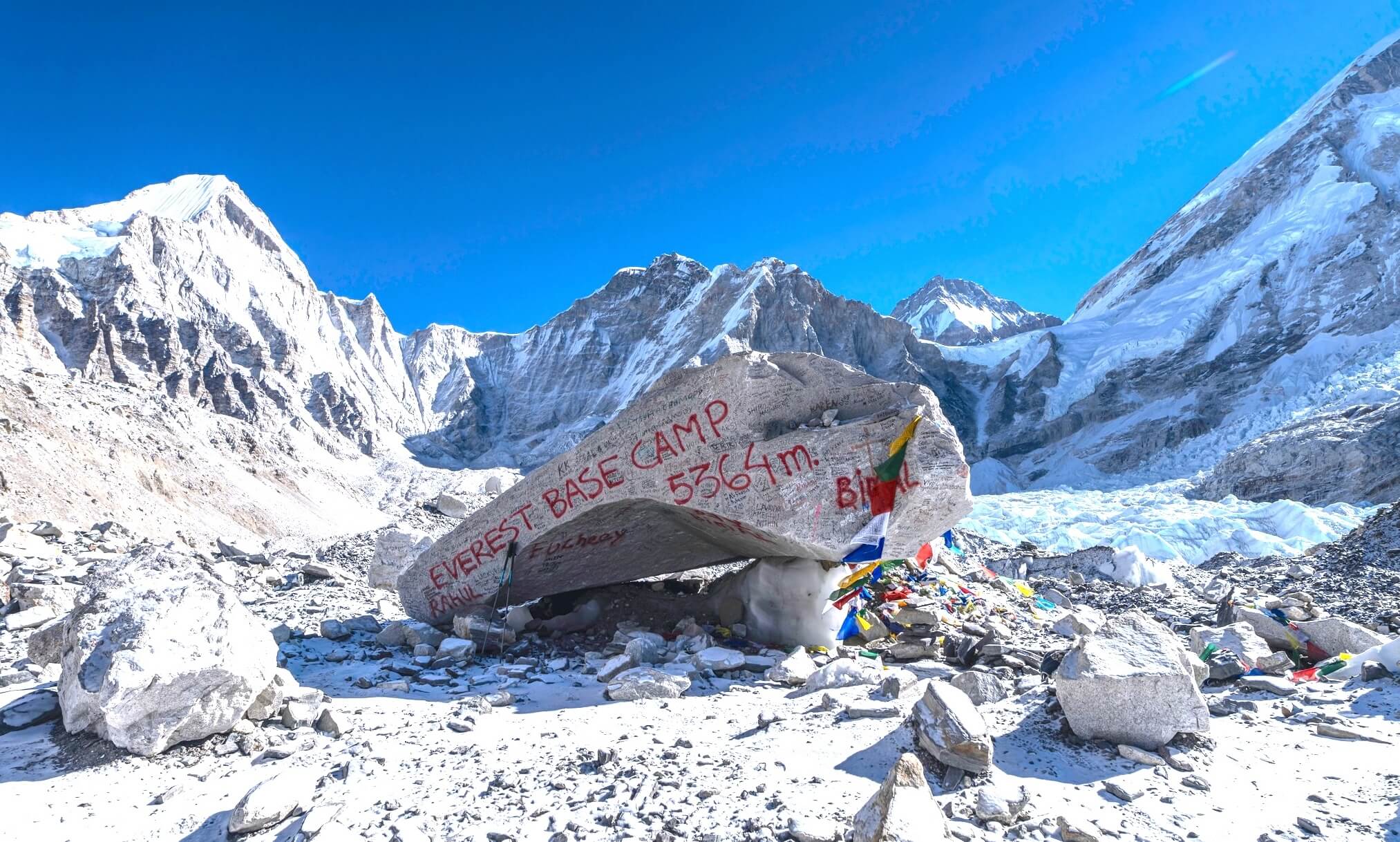
Everest Base Camp is reached on a broad surface track. At 5,364 meters (16,994 feet) above sea level, Everest Base Camp is located at the base of the majestic Mount Everest. From here, you may enjoy the breathtaking view of Khumbu Icefall.
You will also be treated to a breathtaking panorama of the Lingtren and Kuhonbutsu mountains. You will return to Gorakshep after relishing the accomplishment of making it to Everest Base Camp. Camp for the night at Gorakshep.
To witness the sunrise and the glistening Mount Everest in the morning light, we begin our journey from Gorakshep to Kala Patthar at 5,545 m (18,192 ft) this morning.
You can clearly see Everest from Kalapathar. It is therefore regarded as the best vantage point in the whole EBC region. In a similar vein, the summit of the hill offers a 360-degree vista of the Himalayan giants, including Khumbutse, Changtse, Lhotse, and Nuptse. The climb is steep and challenging at high altitude, but the sunrise views over the snow-covered peaks make for an unforgettable experience.
After spending time at Kala Patthar, the trail descends back to Gorak Shep before continuing downhill toward Pheriche. As the altitude decreases, the walk becomes more comfortable, passing through rocky glacial paths, alpine valleys, and traditional mountain settlements. Reaching Pheriche offers a well-deserved rest after a long and memorable day in the heart of the Everest region.
We will eventually walk to Gorakshep before returning to Pheriche, our next destination. The night will be a little warmer and lower once we get to Pheriche. Spend the night in Pheriche.
We hike back to Namche from Pheriche. Leaving Pheriche, the trail gradually descends through open alpine valleys with beautiful views of snow-covered peaks and traditional stone-built villages. As trekkers lose altitude, breathing becomes easier, and the landscape slowly changes from rugged high-altitude terrain to greener forests filled with pine and rhododendron trees. The route passes through peaceful settlements and suspension bridges above the rushing Dudh Koshi River.
Continuing toward Namche Bazaar, the journey feels both relaxing and rewarding after the challenging higher sections of the Everest trek. Overnight in Namche Bazaar.
Your hike will come to an end today when you return to Lukla. You will first hike down the Dudh Koshi River to Phakding, traversing several suspension bridges along the way. With prayer flags, Chortens, Mani walls, and tiny Gompas lining the settlement, there was a slow awakening in Cheplung before climbing to Lukla. Spend the night at Lukla.
We’ll have another exciting flight back to Kathmandu today after breakfast in Lukla, where we’ll get one last up-close look at the mountains. You will be taken to your hotel upon your arrival in Kathmandu. We provide you with a cultural supper program in the evening. Spend the night at the hotel in Kathmandu.
You are leaving for your home today. Three hours prior to your departure time, a Bold Himalayas representative sends you off at the airport. You can accompany Bold Himalaya on another exhilarating journey. We can start planning your fantastic trip right immediately.
Trekking Map
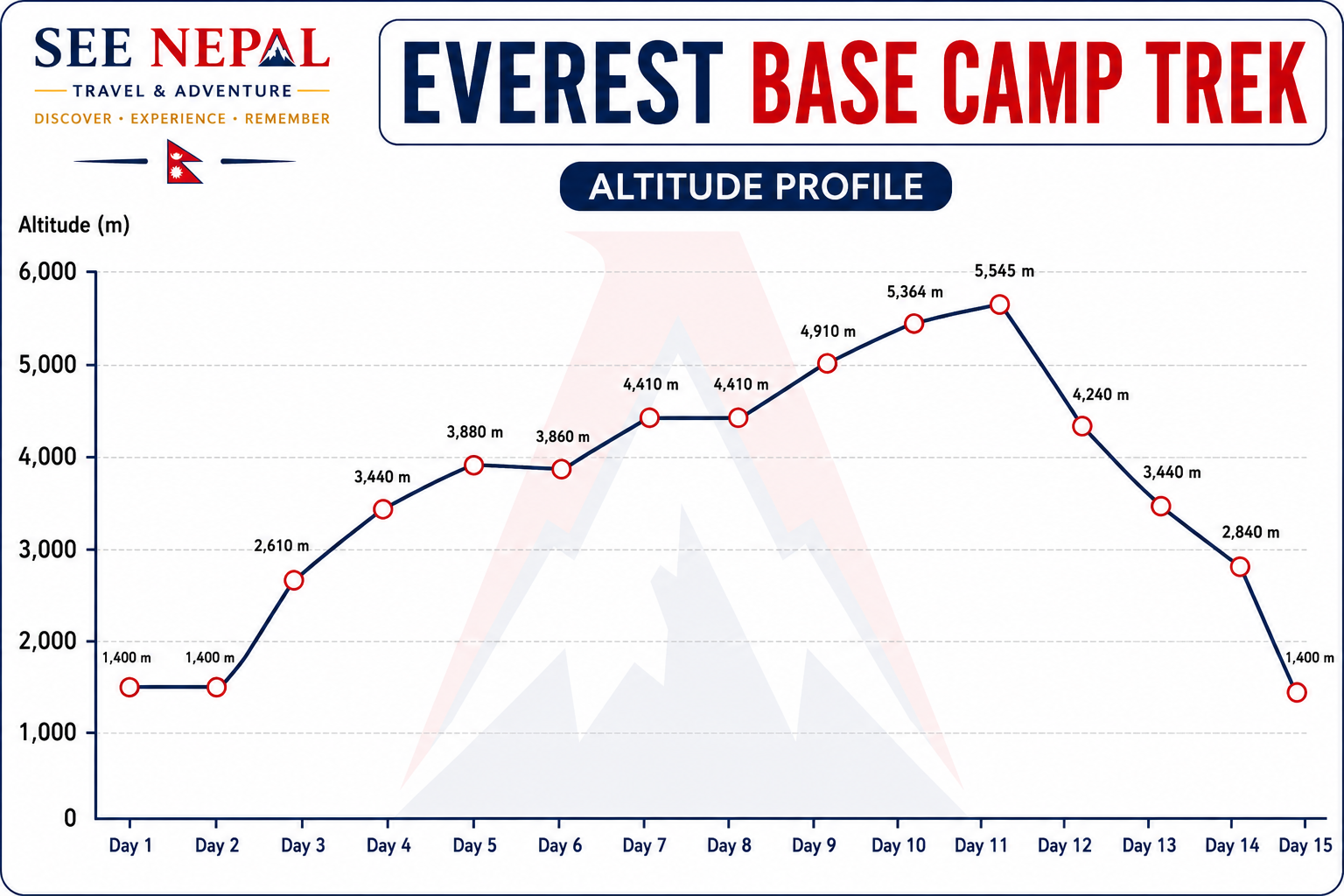
Altitude Profile
Inclusions & Exclusions
What's Included
All ground transportation during excursions, including airport pickup and departure.
Domestic flight based on the schedule to Kathmandu-Lukla and back to Kathmandu.
Accommodation in Kathmandu at three-star hotel with twin beds and breakfast.
Typical guesthouse/lodge for trekking.
All meals during the walk (breakfast, lunch, and dinner).
Some seasonal fruits
Up to five persons can use one guide; beyond that, more guides are provided for every five.
Experienced guides, and porters, with their food, accommodation and insurance.
Khumbu Pasang Lhamu Rural Municipality Permit and Sagarmatha National Park Permit
First Aid Kit
A sleeping bag and a down jacket (If necessary-return after trekking)
T-shirt, trip certificate, and duffel bag
One farewell dinner program in Kathmandu.
All Government taxes and service fee
What's Excluded
Extra lunch and dinner in Kathmandu
Bills for dessert and bars and your personal expenses
Your travel insurance and international ticket.
Tips for the members of the trekking crew
Any other expenses not mentioned in itinerary
Equipment List
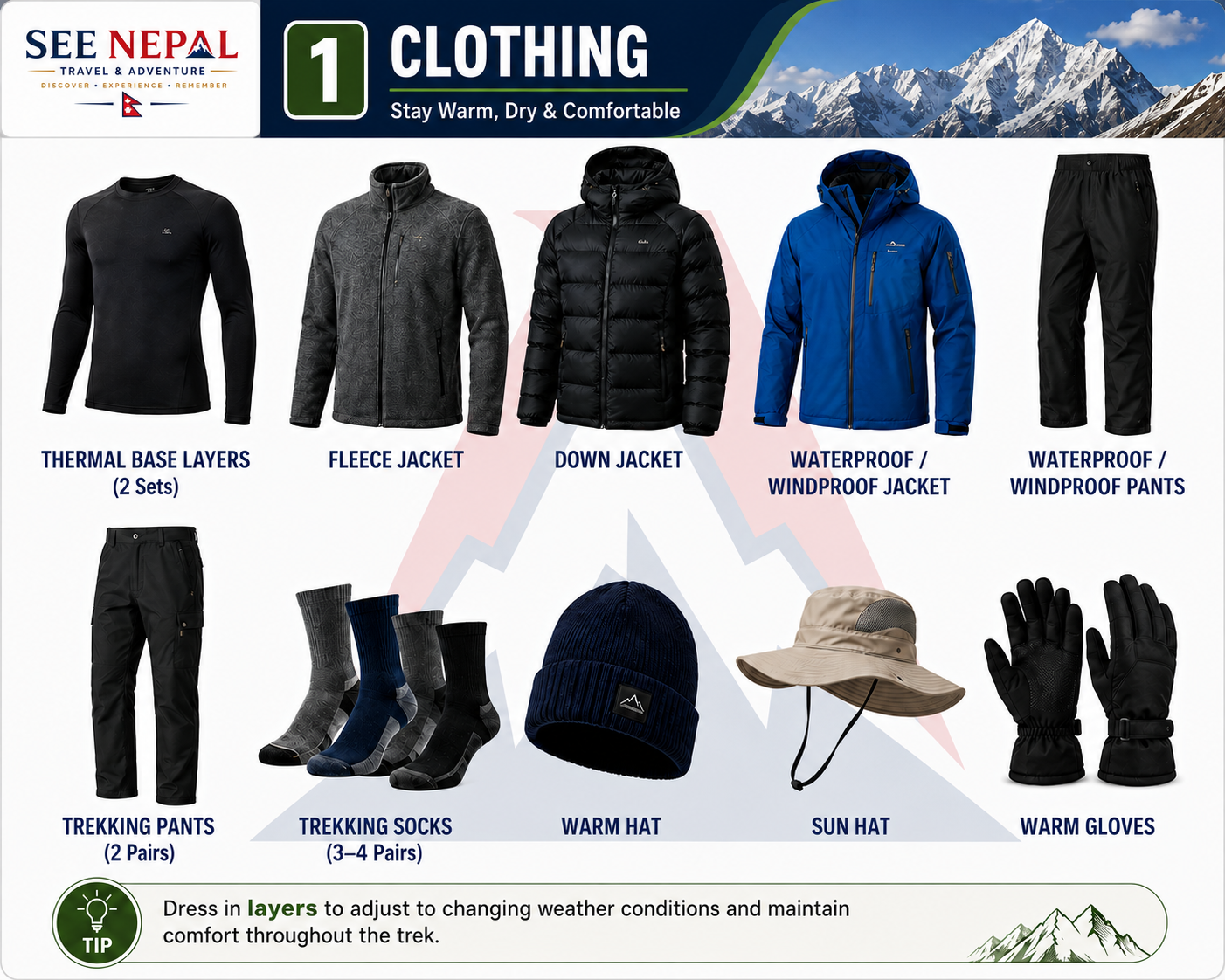
Clothing
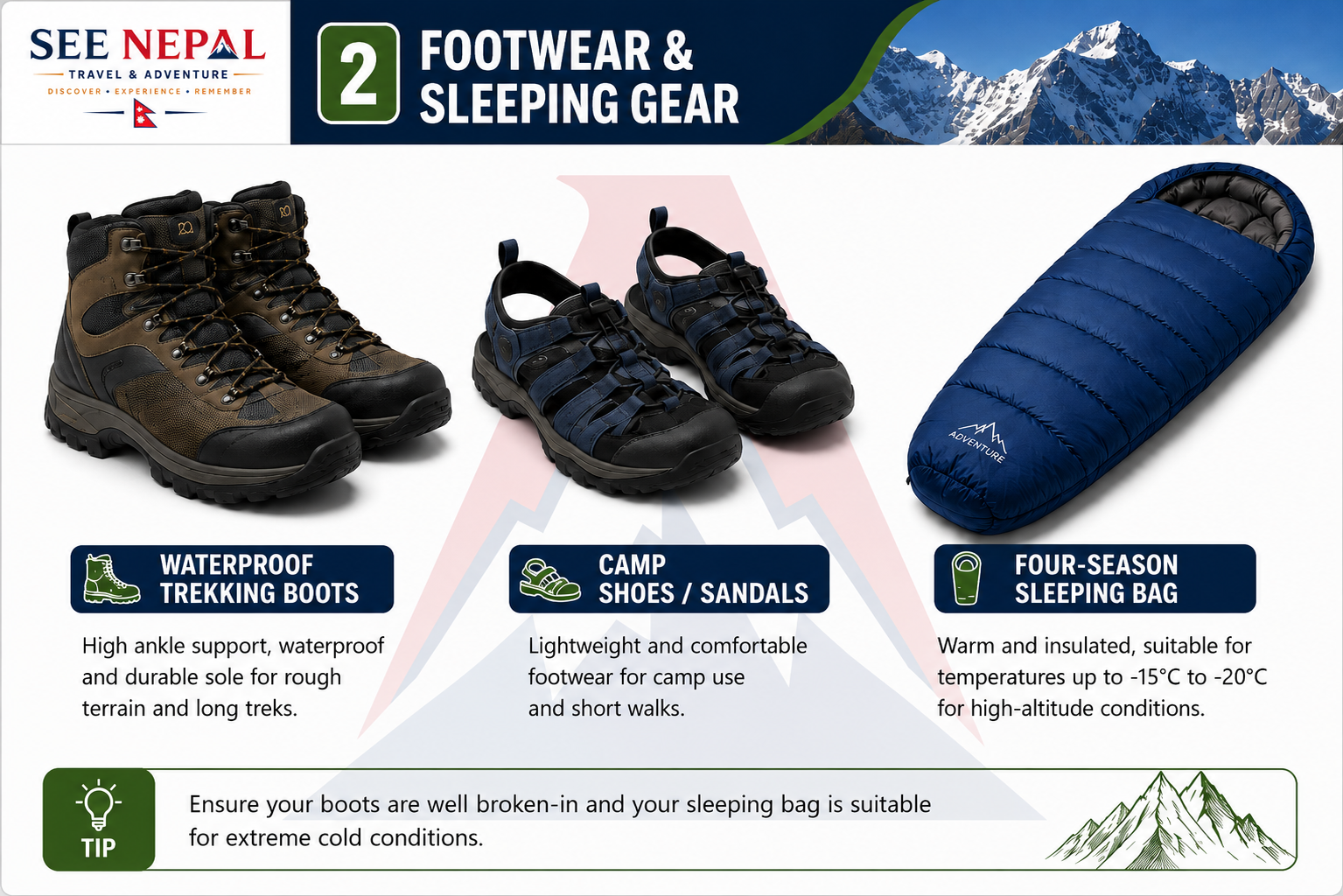
Footwear & Sleeping Gear
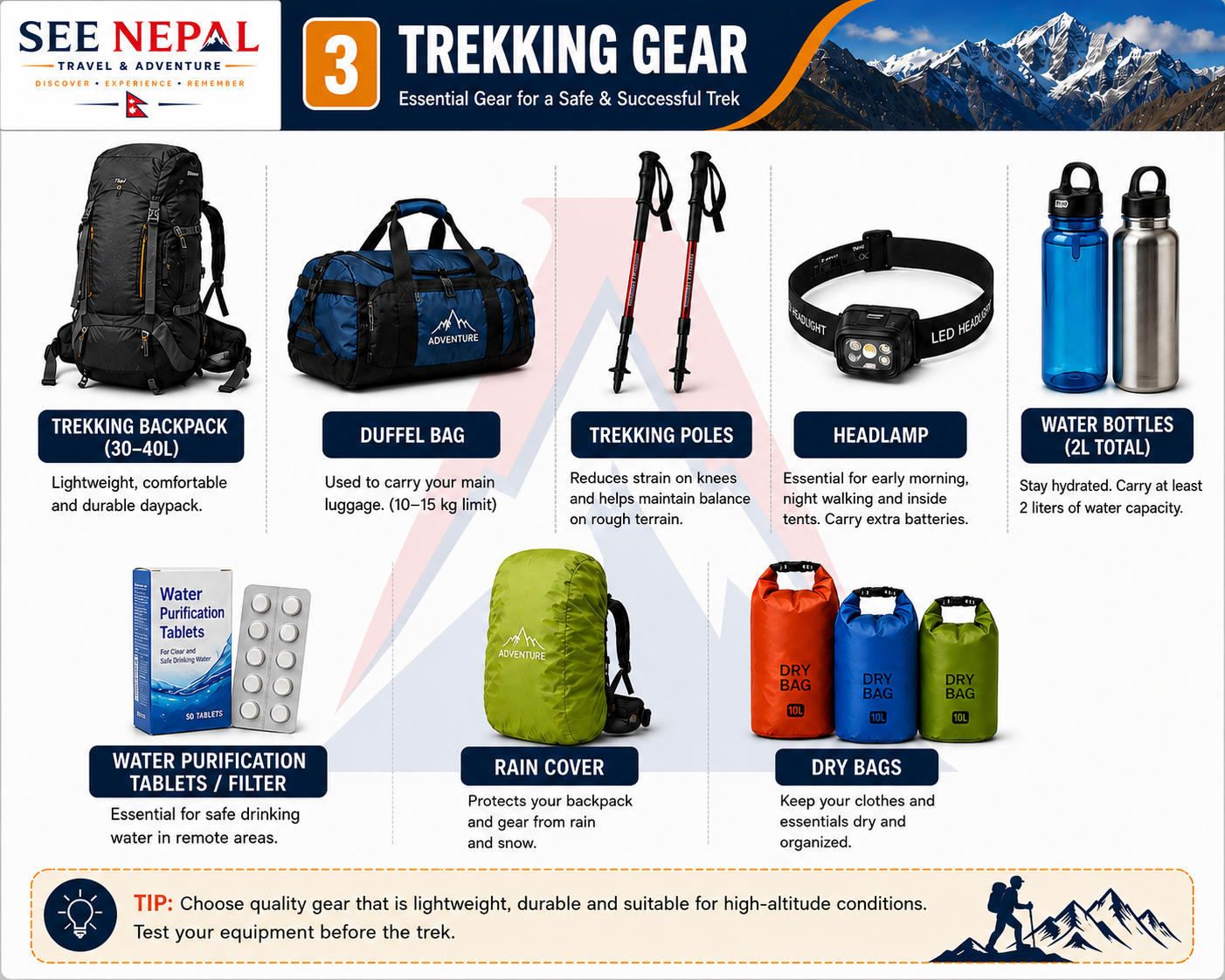
Trekking Gear
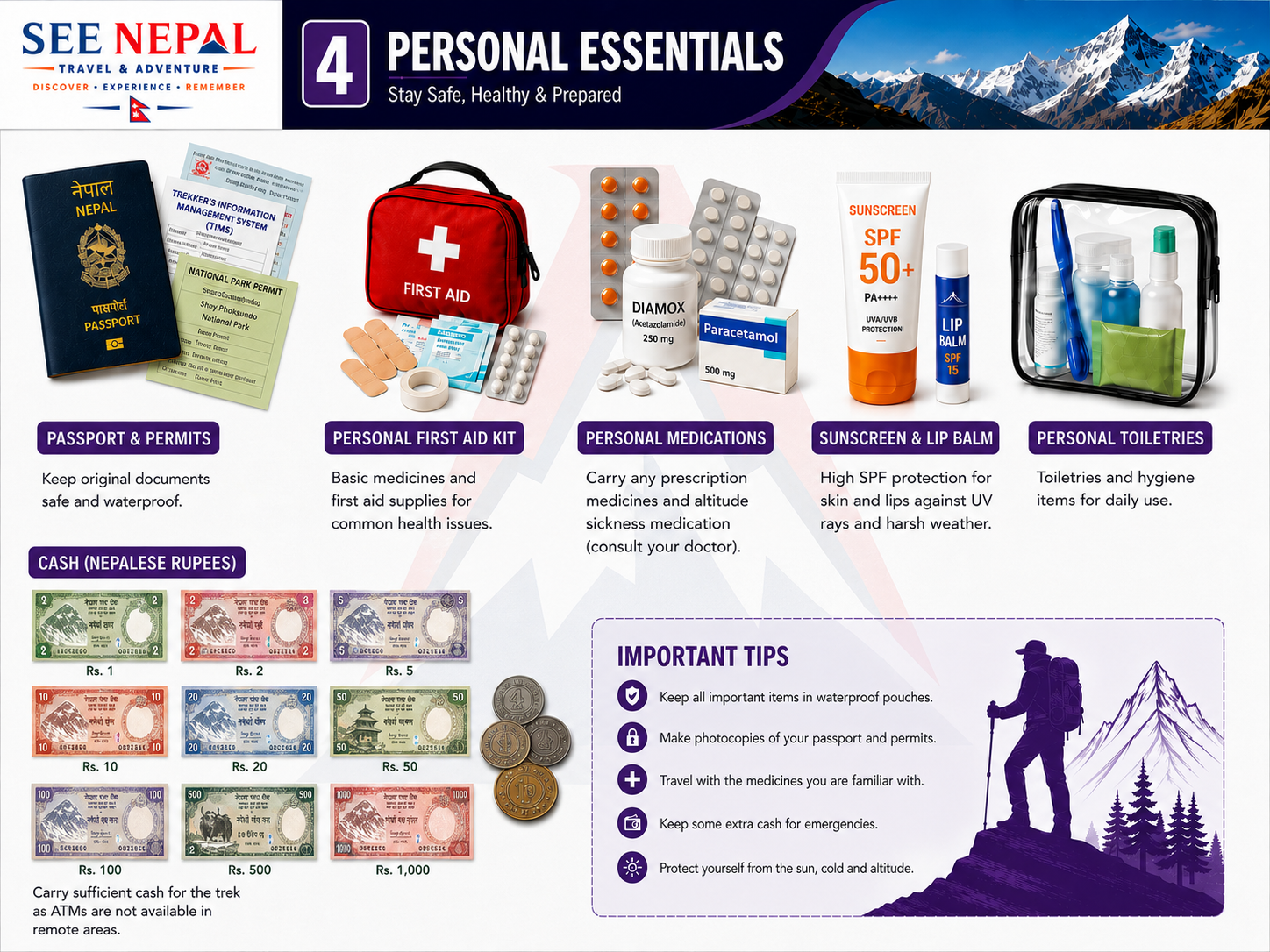
Personal Essentials
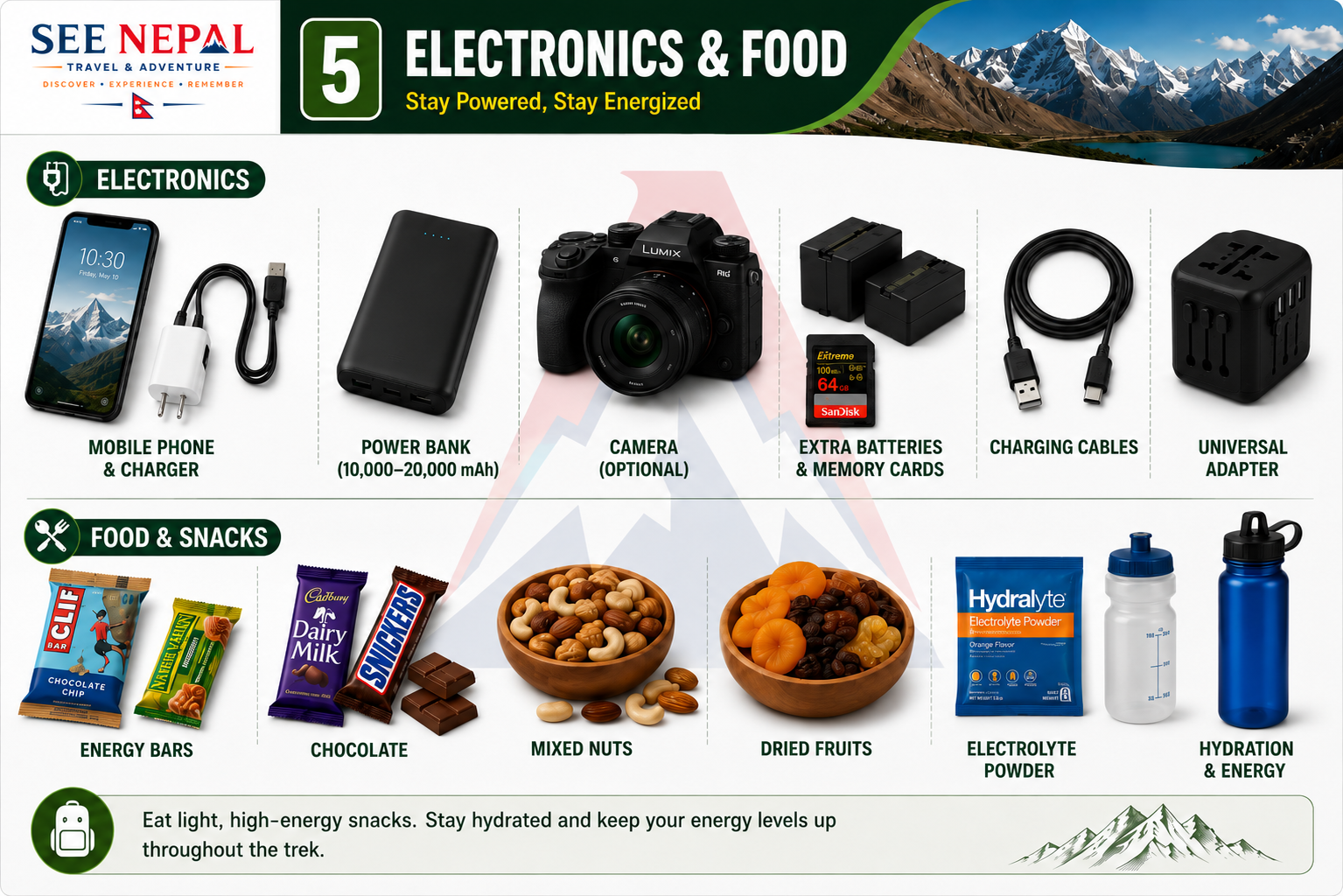
Electronics & Food
Frequently Asked Questions
The Everest Base Camp trek is located in the Khumbu region of northeastern Nepal.
Well, this isn't a typical query, yet the majority of people believe that the trek to Everest Base Camp is risky BUT Not True!. Everest Base Camp is visited by a large number of hikers every year, ranging in age. In terms of avalanches and landslides, the journey is not very hazardous, but AMS, HAPE, and HACE are the main issues. Everything will work out fine if you adhere to the mountain restrictions and the elevation (AMS).
Our Everest Trek has no upper limit as long as participants are healthy and eager! The Everest Base Camp Trek has been taken by families with children as young as 7 years old, and our oldest hikers were in their late 73s. Families are advised to plan a private trek and a few additional days.
We take steps to safeguard the safety of all of our trekkers, including men and women. Overall, Nepal is a highly safe country that welcomes international tourists. The lodges we frequently stay at have long-standing ties with us, and we are confident in their security and dependability. Additionally, while trekking, our guides are always aware of the whereabouts of all of the tourists. We travel in small groups so that we may more easily stay in touch. If you read reviews on TripAdvisor or Google, you'll find a lot of feedback from female solo travelers who visited Nepal alongside us.
Our guides are qualified and experienced in handling crises, but be assured that we take every measure to proactively protect the safety and wellbeing of our trekkers. You will be transported to Kathmandu for medical care if necessary by rescue helicopter, which will be called by our guide using the details from your trip insurance.
The 12-day hike to Mount Everest's Base Camp is from Kathmandu to Kathmandu. The original schedule includes two more hotel rooms in Kathmandu, however the 12 Days to the Everest itinerary excludes Kathmandu. However, the airline tickets to Lukla, the guides, and the remainder of the itinerary will be the same as what was specified in our trip plan. Trekking Agencies describe it as the fastest Mount Everest Base Camp trip, while Rugged Trails Nepal also arrange on request.
Since we are only visiting from the Gorakshep, we won't be spending the night in the Everest Base Camp. At the Base Camp, there are no hotels; instead, camps are put up for the Everest expedition. Throughout March, April, and May, hundreds more camps will be visible. It takes 3 hours to get from Gorakshep to Everest base camp.
You should talk to your doctor in your home country about the benefits before you travel. Many people opt to use it as a preventative measure for altitude sickness. It is advised to take if you wish to, in which case you should take half the tablet the day before you fly to Lukla. You do experience the adverse effect of having to urinate more frequently than usual. This means that there could be a few cold midnight wake-up calls for the bathroom.
Mount Everest Trek travel insurance is an insurance policy designed to protect travelers in the event of an emergency while trekking in Nepal. The policy covers medical expenses, evacuation, and repatriation costs in the event of an accident or illness. It also provides coverage for trip cancellation and interruption, lost or stolen belongings, and travel delays.
After scheduling their trek, trekking participants are kindly asked to give their complete insurance details. We will use the insurance policy and informational papers you supplied us in an emergency. We can plan an efficient rescue operation, transport for immediate medical assistance, etc. with its assistance. Please be sure that your insurance covers all expenses related to mountain rescue services.
A beginner can most certainly do an Everest base camp trek, however it is important to note that this is not a trek for beginners. It is an mederatly challenging trek that requires a high level of fitness, as well as some experience in high altitude trekking. That being said, if you are a beginner who is determined to do this trek, there are some things you can do to better your chances of success. First and foremost, it is important to get in the best shape possible before attempting the trek. This means not only working on your cardiovascular fitness, but also doing strength training to build up your leg muscles. It is also a good idea to try to get in some acclimatization hikes before the trek, if possible. This will help your body get used to the high altitude and will make the trek itself a bit easier. Finally, be sure to listen to your body and take things slowly. This is not a race, and there is no shame in taking a few extra days to complete the trek. If you take your time and are well prepared, you will be able to complete the Everest base camp trek as a beginner.
Prices for Mount Everest tour packages vary depending on the company you book with, the length of the trek, and the time of year you go. However, you can expect to pay around $1400, 1500 for a basic package. Group cost and Luxury Everest Base Camp Tour Package cost extra, get in touch with our tour expert!
The best time of year to trek to Everest Base Camp is between April and May, or October and November. These months offer the best weather conditions, with clear skies and relatively mild temperatures.
NOPE! Asian, Indian, and continental cuisine are all delicious and easily accessible. You should get used to dal bhat even though Nepalese cuisine is amazing. Bring your favorite chocolates, protein bars, and snacks.
You can indeed take a shower. Showers in Namche, Lukla, and Pangboche are typically free, depending on the lodging and amount you pay. But the cost will rise as you go higher. Don't worry; everyone on the path smells the same. Staying warm will still be the key challenge. The wait is certainly worth it after going without a hot shower for days. It ultimately feels even better as a result of it.
To ensure that all of our valued customers are okay, safe, and feeling well, the Rugged Trails Team Leader will interact with them by WhatsApp, Phone, Messenger, etc. at least once every day through our trip leader. You could receive some signals when traveling, but they won't be particularly strong at high altitudes, depending on the network you choose. But in Kathmandu, it's simple to get a local SIM card. Typically, all of the lodges and motels where you'll be staying will have Wi-Fi.
Electricity, battery recharge, and water are extremely important on the Mount Everest trekking. In all lodges, electricity is accessible (some places free) to recharge devices like cameras and phones. You may either bring boiling water with you on the walk or buy mineral water in a pack along the way. A water purifying tablet is also available to you.
Absolutely; in fact, some individuals now use helicopters to return to Kathmandu. It is preferable to take the scenic fly if you want to return via the same traditional trek route. More info: Fly off of the Everest Base Camp Trek Helicopter tour is listed on our website.